8.12.2006

THEATER - "Marco Million$ (based on lies)"


Marco Million$ (based on lies), Waterwell’s adaptation of Eugene O’Neill’s little-known play, is a drama wrapped in slapstick surrounded by vaudeville drowned in cabaret. It is also an excellent example of how to refurbish and contemporize a stolid piece for a hipster crowd.

The plot hews closely to O’Neill’s, but the emphasis is now laugh-a-minute humor, a point occasionally taken too “seriously” by the troupe. Some jokes go a little too far, like in a poetry slam inspired by the far-more cultured II.iii of O’Neill’s play. (Black Jack the Vicious recounts his love for a bunkmate who “uncorks my scuppers/and pierces my billowing jib/8½ fathoms with his yardarm/I can feel it in my rib.”) Some don’t go far enough: two mock-1930s-film newscasts serve as summary of I.ii (Marco receives a papal commission to seek out Kublai Khan) and II.ii (Marco’s party prepares to escort Khan’s daughter, Kukachin, back to their Italy). Neither is particularly funny, and they serve only to point out how much of O’Neill’s work is riddled by exposition and superfluity. It’s not the sort of reminder you want in an otherwise-upbeat modernization.

Luckily, the players of Marco Million$ are hit-and-rarely-miss. Wallowing in flamboyance (especially Kevin Townley), they wend their way through so many accents, characters, and scenes that it’s hard to be less than impressed. Though the production is at heart quite sophomoric, it has such indefatigable energy that the show remains constantly captivating. Any unevenness can be attributed to the fact that all five cast members contributed to the script, and more so to the unevenness of O’Neill’s own script, which, in epic tedium, spans twenty years. In Waterwell’s hands, the play becomes such fun that we don’t mind that these good ol’ boys can’t sing in harmony, or that their waltz is a bit clumsy. Their instinct and rhythm is spot on (so is their tango). The scope is ambitious enough to make scenes good even when they’re not, and shining stars like Rodney Gardner, who plays a Mafioso Kublai Khan, eclipse the rough spots with their brilliance.

As for stars, director/actor/writer Tom Ridgley is a supernova. The troupe jests about the difficulty of transitions, but under Mr. Ridgley’s eye, they’re just another opportunity for a jest. Stale blocking? Now you jest. From Matrix-styled shifts in camera aboard a merchant ship to umbrella-fashioned boats to the piquant, zesty lighting (Stacey Boggs’s design), Mr. Ridgley keeps us rapt for a hundred minutes straight.

Marco Million$ also ends up a surprisingly faithful staging of O’Neill’s work. For all the clever emendations and boffo riffs, the closing minutes get to the heart of the story: greed wins and love suffers when the powerful face the emotionless. With the bluesy gospel finale’s condemnation of “the avaricious [who] relish in good fortune” we are reminded one final time not to applaud for Mr. Polo: “just throw money.” That cool critique of capitalism’s emotionless glamour is no joke.

8.09.2006

MOVIE - "Talladega Nights: The Ballad of Ricky Bobby"

Stupid is as stupid does, and in Talladega Nights: The Ballad of Ricky Bobby, stupid does 200 m.p.h. And in that driver’s seat, looking comfortable and even—at times—suave, is Will Ferrell (as Ricky Bobby), a picture-perfect model of stupid. Alongside him is John C. Reilly (as Cal Naughton, Jr.), who plays the dumber (but just as talented) version of Ferrell. The only person who doesn’t look comfortable is Sacha Baron Cohen, who plays the villanous French Formula 1 racer, Jean Girard, recruited to take Ricky Bobby out. Trapped in a preponderance of over-the-top negatives, Girard’s accent is mangled worse than Inspector Clouseu’s, his mannerisms are rigid and monotonous, and the fact that he’s gay just seems more like an acknowledgement of America’s own homophobic tendencies than a joke: it doesn’t work. Writer/director Adam McKay (of Anchorman legend) stretches these French-related jokes too far: they’re as repetitive as, say, racing a car around an ovoid track 500 times.
[Read on] at Just Press Play

8.08.2006

MOVIE - "13 Tzameti"

First-time director Gela Babulani has created the cinematic equivalent of the shot not heard round the world in "13 Tzameti" – a chillingly taut drama where the empty click of a gun is just as potent as the shot itself. Once Babulani gets beyond his initially teasing camerawork and transforms his protagonist, Sebastien, from a financially-strapped immigrant in rural France to an accidental contestant in the illegal world of a high-stakes Russian-roulette tournament, we have an effective bit of suspenseful noir on our hands.
[Read on] at Show Business Weekly

8.07.2006

THEATER - Anais Nin: One of her Lives


As is too often the case, fact is rarely as fanciful as fantasy. Most of playwright/director Wendy Beckett’s drama Anaïs Nin: One of her Lives is imagined or extrapolated from Nin’s erotic diaries, Anaïs’s character is filled with understanding, not passion, and seems unable to live off the page. One of her Lives is not a bad play, but it is an awkward one, a series of loose, drifting encounters in 1930s Paris between Nin and the far-more interesting Henry and June Miller. The presentation of this material isn’t original: the 1990 film Henry & June used similar details, and Beckett doesn’t bring enough theatricality or insight to Nin to justify the work on that level. Where it shines is as a literary passion play, climaxing in a slow, sexy seduction between Henry and Anaïs's recitations from their journals. But words only get you so far . . .

In this case, Beckett paints herself into a corner with the sub-plot she’s erected (perhaps to distinguish this work from other adaptations). Nin’s abortive sessions with the psychologist Dr. Rank (not the Chekhovian one) abound in cryptic and meaningless riddles and the dreamlike encounters between Anaïs and her parents remain dreamy and without substance. Though we learn that one sequence beween Anaïs and her long-gone father is real, there’s nothing to draw from the scene itself, which is the real problem with the play itself: a lack of resolution.

Why focus on Anaïs Nin? She may be an erotic woman in her diaries (and certainly has a fully encompassing sexual history), but the character that Beckett constructs is a little girl prone to giggling uncontrollably or weeping tragically, without any real sense of self or being. Alysia Reiner and David Bishins, who excellently portray the Millers, upstage her without even saying a word. This fits in June’s case, as she’s an explosive personality who sucks in and destroys the people around her, but for Henry, presented here as a gruff yet gentle skirt-chaser, their physical relationship never smolders, only their words.

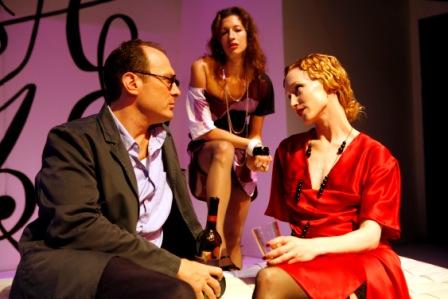
Angela Christian, who plays Anaïs, is cheated by a flimsy and quieting French accent that minimizes her at every turn. She has a great command of her body (which probably comes from her experience in musical theater), but nowhere to take it—hence all the spurts of pacing back and forth. There’s drama at the heart of this love triangle, but Beckett’s play doesn’t capture it: the whole construct, from the calligraphic walls to the book-stacked set, is too chaste and Anaïs Nin sorely needs of some vulgarity.

8.06.2006

BOOK - "The Omnivore's Dilemma"

While discussing the industrial organic (an oxymoron realistically, but not legally), Michael Pollan, in his new book The Omnivore's Dilemma, connects browsing Whole Foods to Barnes and Nobles. Both sell attractive products that hook you in with clever designs and jacket quotes—the ones from Whole Foods just tell a different type of story, a story of happy farms and happy animals. Pollan calls this sales pitch Supermarket Pastoral, but then wonders, as he looks at how people manage these farms, at the rather lax standards on the governmentally owned word "organic," and at the battle between Big and Small Organic, whether their brand of "cutting edge grocery-lit" is more fact or fiction.

Well, as anyone who has ever read a non-fiction expose on the food industry before, most of what you believe about food turns out to be as fabricated as the synthetic (and sometimes "natural") ingredients. As it turns out, Pollan has invented a type of grocery-lit, one that likes to perambulate across aisles on historical fact, innovation, and digression. Unlike these corporate food writers, as much manipulators of the sentence as of meat, Pollan's heart really is in the right place, and though his book has a lot of repetition, it's surrounded by solid fact and enjoyable—often mellifluous—writing. I haven't been so thoroughly disgusted yet entertained since reading excerpts from Upton Sinclair's The Jungle.

Pollan, who is prone to extending metaphors, is also a fantastic imagist, and his combination of the two is what makes him a thrilling journalist, one of the few people who can make nonfiction crackle. For instance, take his first impression (albeit fifth or sixth draft) of a farm he visits in the industrial chapter:
"A sloping subdivision of cattle pens stretches to the horizon, each one home to a hundred or so animals standing dully or lying around in a grayish mud that, it eventually dawns on you, isn't mud at all. The pens line a network of unpaved roads that loop around vast waste lagoons on their way to the feedyard's thunderously beating heart and dominating landmark: a rhythmically chugging feed mill that rises, soaring and silvery in the early morning light, like an industrial cathedral in the midst of a teeming metropolis of meat."
Is that Americana or what?


It's a pleasure following Pollan as he dissects the origins of four distinct American meals, from McDonald's "nuggets" (a food group all to itself) to Whole Foods to Polyface farm to physically hunting and preparing each item himself. (Pollan calls this last one “the perfect meal.”) This enjoyment makes his actual findings easier to digest: for example, we have not only transformed grass-eating ruminants into a bunch of corn-munching pieces of steak, but this process has increased the risk of our meat carrying a disease that our acid-riddled stomachs can't break down. “The species of animal you eat may matter less than what the animal you’re eating has itself eaten.” We recklessly use cheap corn at the cost of our soil, our increasingly indebted (and subsidized) farmers, and ultimately, our health. I take it back: it's plenty hard to digest; it's just not hard to swallow (and that, in a nutshell, is the problem with America's eating).

Pollan’s a reliable and knowledgeable journalist when it comes to all this data. He’s been covering food-related trends for years now, and his “grassroots” experience allows him to easily convey complicated facts about biomechanics or the benefits of a perennial ecology (not to mention what, exactly, that is). He’s also quick with a metaphor or parallel for every situation; rather than rely solely on quotes, he works as much from a storyteller’s perspective as from his characters, and his embellishments are light and sculptorly. Who else would compare the evolution of plant pesticides to how European nations acted during the cold war? Who’d describe bits of deadly nightshade, avoided by the natural intelligence of ruminants, as “forlorn florets of cauliflower languishing on a picky child’s plate”?

When it comes to conclusions, Pollan occasionally leaps beyond his facts. His simple questions (e.g., is organic food better? Worth the extra cost?) ramble to digressions (“better for what?”) and eventually conclude that while the industrial-organic food of Whole Foods is usually tastier and healthier, it is no more sustainable—the whole point of going organic—than a conventional TV dinner. (It is, however, a contradiction that is “possible to live with” and “sometimes...necessary or worthwhile” to hold.)

This is a flaw of The Omnivore’s Dilemma (and other tell-alls): a lack of solutions, an abundance of critiques. (It’s easy to talk about our efficient inefficiency.) After exploring the beauty of a sustainable farm that practices polyculture and true organic practices, Pollan pinpoints what led to the favoring of “a biologically ruinous meal based on corn,” but doesn’t offer an economic recourse. Then again, that’s not really his job: you wouldn’t expect a author of a cookbook to make the dish for you; you can’t expect Pollan to reorganize agribusiness for the government. (I’d be willing to let him try.)

In the third and final segment of his book, Pollan forgoes making conclusions, and instead illustrates the trials and tribulations (and satisfactions) of hunting wild Sonoman pig and foraging through back forests for mushrooms (which includes a short digression on the “lunar energy” and so-called mystical properties of the fungi). Here, the prose flows away from facts to observation, to “hunter porn.” But these segments—which relate a more-primal experience that most of us are unfamiliar with—are as engrossing as they are irrelevant, since it’s a given that most people don’t have the resources, leisure, or ability to hunt and forage their own food anymore. (Even the author’s no expert, and relies on the expert opinions of his entertaining guide, Angelo, to overcome his crippling mycophobia and his lack of familiarity with rifles.)

We live vicariously through Pollan’s pictures instead:
“With my eyes I followed the silvery line of the stream up through the woods to the crest, and that’s when I saw it: a rounded bloack form, a negative of sunrise, coming over the top of the hill. Then another black sun, and another, a total of five or six, I couldn’t be sure, popping over the crest in a line like a string of huge black pearls.”
The Omnivore’s Dilemma is a thoroughly engrossing and exciting read, the type of non-fiction that has social relevance that doesn’t come at the expense of personal exuberance. And wherever the book might linger too often in stark fact, the narration is driven by the underlying conceit: “It is odd that something as important to our health and general well-being as food is so often sold strictly on the basis of price.” This book is a rich literary meal that you can’t afford not to finish.

---------------------------------------------------------------------
[Note to the publisher: I don’t recall ever reading a book with so many typographical errors. Granted, I spend a portion of my days proofreading—I’m more disposed to notice these things than the average gadabout—but consider placing more care in your editing so as to avoid things like: “...though it may be that animals like us that eat morels do help them disperse their spores as we move then [sic] around on the way to our plates.”]

8.05.2006

CONCERT - Muse at the Hammerstein Ballroom, NYC, 8/3/06

Think of the Rapture. Think huge piercing walls of light, think stereotropic shimmers careening off fans, think of a multimedia kaleidoscope revolving around four giant, baroque test tubes, then think again. A chord, a slow ebb, a beat, a rhythm, a pulse . . . and then a wail. Matthew Bellamy, howling just a little louder than his guitar, trying to get the images into our eyes even as he pumps the music—loud reverberant chunks—up our soles, through our spines, into our souls. There’s Chris Wolstenholme, stage right, holding everything down with a bass guitar and an occasional chorus. Dominic Howard, center, seated on a monolithic throne of drums and poised to strike. And bonus performer, Morgan Nichols, lurking behind Matt, but not with the sinister vibe that some of the Muse songs convey; he’s there to maintain the samples and to play the keyboard. And then there’s you, bathed in this radiant light, this luxuriant sound – yes, think of the Rapture.

This particular miracle comes with a name – “Butterflies and Hurricanes” – and if you’re not adequately prepared, has the potency of a curse to boot. Until you’ve seen this song live, you haven’t heard Muse. And once you’ve been cowed by the brilliance, it’s hard to go back to the processed sound of a monochrome CD, spinning silently in its little shrine. Following the overall Muse formula, “Butterflies and Hurricanes” begins with a soft, foreboding lull, a slow sinking that, after a minute, you suddenly realize has started, impossibly, to rise. The CD its from, Absolution, can’t adequately capture the surge in energy, but it's even worse at translating the song’s unusual bridge. After reversing into a neo-classical instrumental section, it fades out in a twinkle of staccato keystrokes, only to return, seconds of silence later, with Matt on the piano. In the midst of a rock concert, amidst sweaty, crowd-surfing fans, an instrumental homage to classical music has taken center stage; what’s more, it’s crawled under your skin, and the nuances tickle your body like a sudden, delightfully delusional fit.

It’s 10:00 in the Hammerstein Ballroom, NYC. I don’t have children, and if I did, I certainly wouldn’t know where they were. Muse has been playing for an hour (long enough to blot out all but the knowledge that the openers, The Cloud Room, were terrible), and they’ll play for another forty minutes. There have been ballads, there’s been fight music, there’s been their darkly fantastical alternative rock, and there’s been a lot of Matt, working the guitar as much as the stage, scrooning (screaming + crooning) a slick, solid sound from a world born of synthetic harmony and angry guitars. I’m blown away by the lush, vibrant feeling rising once more through my bones as we segue into “Feeling Good,” a sultry mix of lo-fi jazz and hard rock, and yes, I think, I am feeling good. How could I not?

(The next day, listening to my Muse collection, the recordings seem tame. “Hysteria,” which brought the whole audience at least three feet into the air with its rocketing line of guitar shreds, now seems once removed, more intellectual than emotional. “Stockholm Syndrome,” which erupted through my body, seems quiet even after I turn the knob on my stereo to the max. Live, I remember the trippy electronic chorus actually tripping people up, the guitar’s jagged lead back in to the meat of the song made the comatose wake up. Give me a few days—let me wash the raw feedback from my brain—and I’ll be fine with this silvery imitation. But let me think of the concert instead.)

The point of this tour is presumably to help bolster sales of the new Muse CD, Black Holes and Revelations, which hasn’t gotten overwhelmingly favorable reviews. Well, I didn’t like the CD at first either, but as I said earlier, they weren’t listening to Muse properly. Performed live, crackling across that fourth wall with the intensity of stagecraft and the wit of their songsmithery, it’s a great album. “Take a Bow,” an opening number for the album and this tour, builds from an oscillating series of synthesized notes to at last proclaim, in breathy tones hurdling over a wall of guitar strokes, “Burn/you will burn/you will burn in hell/yeah you’ll burn in hell/burn in hell/burn in hell/burn in hell for your sins.” In concert, it’s like watching Muse summon the devil himself to punish an unnamed but corrupt, charismatic leader of a free country who brings death and destruction to all he touches.

With the exception of “Starlight,” the album’s title track, all of the new songs on this tour are great to watch. “Starlight,” incidentally, isn’t bad—it’s just outclassed by the rest of the concert on account of being too cute, and being too similar of a ballad to their older work. Their best new song, “City of Delusion,” which counterposes a sterling trumpeter against a swooping violinist, was unfortunately not performed, and this exposes the one flaw of the set list: an overemphasis on high-octane established hits, and not enough time with their more exotic and experimental work, or slow songs, like “Ruled by Secrecy.” Instead, they performed tracks like “Supermassive Black Hole”—their first single, which is close to being a progressive pop-rock song, and owes much of its beauty to Gorillaz—and an adapted version of “Knights of Cydonia,” their fight-music finale. With the use of the projector screens, the audience rose to their feet, screaming the chorus: “No one’s gonna take me alive/the time has come to make things right/you and I must fight for our rights/you and I must fight to survive.” (As opposed to their performance of fan-favorite “Time is Running Out,” which had us belting the chorus anyway.)

Muse has reached a point where it has amassed enough certified hits to make their tours a preview of their eventual “Greatest Hits.” It’s a little stunning to realize that, solid as this show was, it still left out plenty of great hits, like “Hypermusic” (a perfect eponym for both the song and what Muse performs) and “Space Dementia.” One only hopes that future tours will not be needlessly reliant on their new CD (though it’s hard to say that a song like “Invincible” is a crutch so much as a blessing) and that some of the popularly bland hits like “Plug in Baby” will be excised in favor of more varied songs like “Screenager.”

But hey, I understand the desire to fill a large space with energy, only energy, and nothing but energy, so help them God. And Muse has a sterling bankroll of older hits like “New Born” and “Tsp” that could carry them for the next seven years, even if they never released a new CD. But if this concert is any indication of Muse’s strength and solidarity—how Matt keeps his throat from exploding is a mystery—this Liverpool trio will keep producing their eclectic and increasingly ambient music for fans for years to come. But why wait years? See them now, and then mail your moot CDs to me.

8.04.2006

THEATER - "Everythings Turning Into Beautiful"

Photo/Carol Rosegg

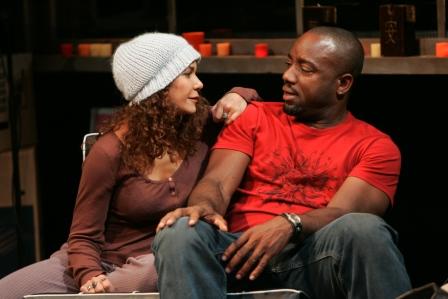
Meet the next genre of theater: the jukebox drama. In The New Group’s new production Everythings Turning Into Beautiful, it’s Seth Zvi Rosenfeld’s dialogue that seems cheesy and the songs by Jimmie James that get to the heart of things. The two actors—Daphne Rubin-Vega and Malik Yoba—also seem more at ease when singing. That comes as no surprise, considering that Rubin-Vega’s claim to fame was originating the role of Mimi in Rent and that Yoba’s attempts to tone down his character mask his talent, something he doesn’t have to worry about when “performing.” Without the music, this would just be an average play about average life—with the music, it is able to liven the tedium long enough to reach the more engrossing second act.

[Read on] at New Theater Corps

8.03.2006

THEATER - "The Maternal Instinct"

Though prone to excess and flaky exposition, Monica Bauer’s play, The Maternal Instinct, is beautiful more often than not: a bittersweet story for anyone who’s ever wanted a baby, and anyone who’s ever been afraid of them. Sarah is the former, her wife Lillian is the latter, and Fred...well, Fred’s the only friend of the family with sperm. Their desires and frustrations are the subject of the next ninety minutes, and with the exception of the comedic sections (played too much for laughs), it’s an interesting hour and a half.

Even the play’s two cumbersome subplots manage to entertain, one intellectually, the other emotionally. The brainier of the two is about Lillian and Fred’s science experiment, an attempt to reprogram (i.e., remove) the maternal instinct. It’s a success—mice are tearing their children apart—except that Mother Courage, a lab mouse, is, by force of will, protecting its young. Dramatically, the scenes are flat, but they do re-enforce Lillian and Sarah’s situation: animals (of which people are a subset) often behave in unpredictable ways. As for the visceral subplot, Lillian, Fred, and Sarah all encounter Terry, a drunk, pregnant, semi-mute superfluity (no matter how well Elise Audrey Manning manages to portray her). These scenes are as repetitive as Terry’s one-word vocabulary, but they end up being cloyingly charming.

The Maternal Instinct rises above these tangents: the cast cushions the rocky portions of the script, and the shining moments of the text compensate for the clumsy simplicity of director Melissa J. Wentworth. Karen Woodward Massey’s performance as the conflicted Lillian makes up for any other flaws, like the lack of a real set or a faulty lighting design—substance trumps appearance any day of the week. Bauer’s play, trapped in the midst of a fringe Fringe Festival at WorkShop Theater, is proof that a good play can overcome adversity. If it makes some necessary revisions to pacing and plot, it can overcome competition, too. The Maternal Instinct deserves to come to term; now it just needs a little help from a qualified midwife.

7.27.2006

TV - SciFi Channel

Intro: Dr. StrangeFi or How I Learned to Love the Bombs
SciFi Channel has four new shows. This is dangerous, considering that the only successful SciFi Channel shows seem to be ones transplanted from other channels (like the Stargate franchise) or remakes of previously established hits (Battlestar Galactica). Farscape couldn't grow beyond a cult following, and neither could First Wave, Invisible Man, or the myriad other attempts made at original cable programming. But these new programs--one drama, one reality show, and two comedies--are worth checking out. And if you don't now, you won't get the opportunity later. So here's the rundown.

Eureka
Handled properly, this could be the next, great X-Files. Handled improperly, we could skip straight to the last season of The X-Files. Eureka is a show about a seemingly innocuous town that harbors a big secret: it is the secret testing ground of all major scientific advances in the last fifty years. Everyone who lives there is a mad scientist waiting to happen; week after week, we get to watch as things go terribly wrong. (That, as you all know, is when things get terribly entertaining.) In the most recent episode, "Many Happy Returns," the cast contends with not just a clone of the woman they just buried, but also with the time-displaced ghost of her husband. These are fresh twists with fun (if a little too wry) dialogue and decent acting.

Where the show trip up is with the script and cast; right now, Eureka is pandering to the audience with joke after obvious joke, and the actors are hamming it up just as much. Science-fiction actors are, theoretically, actors first -- I'd like to think that as Eureka matures, we'll actually see growth in the details of each scene. As for the plot, so long as they don't sacrifice their single-episode format to the plot-arc gods, these writers can make anything happen on the show. I say, let them. And about damn time.

Who Wants to Be a Superhero?
Full disclosure? I went to college with one of the contestants, Nitro G. (I use his secret identity for no other reason than that it amuses me to do so.) Fuller disclosure? So what? That's reality TV; anybody can be a contestant. It's both a good and bad thing that he's the second hero eliminated: the show is easily nerds on parade, and the only place these "heroes" are going is on a panel at the next mid-level comic-book or sci-fi convention. It's a bad thing because Who Wants to Be a Superhero is actually a well-written reality show; Nitro G is now a loser on a show that people might watch.

Flamboyant costumes, improbable characters, and simply silly stunts--Who Wants to Be a Superhero flaunts every nuance of why people like reality TV: laughing at other people. (And who can't laugh at Cell Phone Girl, or how seriously Major Victory and Monkey Girl take this?) This is a new low, which, in reality lingo, should be a major high. The one flaw of the show, but an admitted draw for the comic book fans, is that Stan Lee hosts the programming and controls the votes. However, he never actually speaks to the contestants in person, which gives him the feel of a megalomaniacal, hermetically sealed villain: the anti-Donald Trump.

Though the series has the predictable commercial-friendly twists (with big revelations teased right before the break) and all-too reliable confessionals, the challenges--in other words, the scripted portion--are where this reality show excel. In the first episode, one contestant is eliminated before even entering the heroes' lair...by another contestant, Rotiart, who turns out to be a plant. (His name, when read backwards, is Traitor.) Hidden challenges, like this initial morality test, keep things fresh; the question of how serious some of these contestants are provides the rest of the sinful entertainment.

Later in the episode, I get more guilty pleasure at watching all-too-focused superheroes dash right by a crying little girl [another plant]; the real test, of course, is finding out which heroes think "saving" a civilian is more important than the mission itself. And this is the meat of Who Wants to Be a Superhero: as Stan Lee acknowledges, the show really can't test the outer superhero (that would be funny in another--painful--way), and each episode is a little lesson in morality. And who knows? The winner, who will be the superhuman punch line of many jokes, may even get a chuckle out of Nietzsche.

Garth Marenghi's Darkplace

A documentary by a fictional Stephen King-like character about a fictional show he supposedly wrote, directed, and starred in, in the late 80s for British television couldn't possibly work, could it? Pretentious doesn't begin to cover the bases, but weirdness and originality work in its favor--and there's some invigorating audacity, too.

Unfortunately, the showiness of the format currently overwhelms the humor. The clips from this faux-TV series are flush with enough parody of the genre and era to work solo (in the same way that Soap encompassed its time); the documentary portions, which often interrupt the show-within-a-show's already shaky narrative, are mostly devoid of laughs and don't fit nearly as well. They simply don't need to mine two distinct styles: tacky acting, intentionally awful editing, and painfully funny voice dubbing is where Garth Marenghi's Darkplace triumphs. And that's in the spoof itself, not the analysis of it.

After all, when you've got a hospital called Darkplace built on the bowels of hell, do you really need anything else cluttering the story? The gimmicks--enough blood to make Sam Raimi proud, or low-budget special effects (like throwing a cat into a scene)--are good; the conceit is not.

Amazing Screw On Head
Full disclosure (again)? I'm a huge Mike Mignola fan. His artwork for Hellboy is dark and mysterious, with ominous mythology crammed into every jagged line. The strength of his Dark Horse-published series was enough to make me invest in Amazing Screw On Head, a one-shot that used the same art and supernatural crime-fighting concept for shits and giggles. Not only is the television show drawn in a style similar to Mignolia's own, but the voice-actors (headlined by Paul Giamatti and David Hyde Pierce) understand that it's just for fun.

And really, who doesn't get it? The year is 1868, the country is America, and Screw On Head is a lively head that can screw into various mechanical contraptions. Oh, and he works for Abraham Lincoln. Ah, and he's assisted by his manservant, Mr. Groin. Er, and he's facing the undead army of the gleefully insane Emperor Zombie. Any critic taking this show seriously is seriously in over his or her head.

Suffice to say, Amazing Screw On Head will find its audience in the same devout, cultish fans who loved Duckman and The Tick, two other similarly implausible cartoons. Those who call shenanigans need not watch; the rest of you: hop onboard.

Stargates (SG-1, Atlantis)
Oh, I couldn't resist saying a few words on these returning fan favorites. The only way that a show becomes a fan favorite is by catering to the every whim of a mostly idiotic viewership. After enough seasons, viewers have fallen for the characters, not the plot, and are content to waste hour after hour watching the same (or similar) scenario unfold so long as their "heroes" are killing time with witty banter.

So how does a show survive losing one its main draws? In the case of Stargate SG-1, they transplant characters from another franchise. In this case, it's Ben Browder and Claudia Black from the frakked carcass of Farscape. In order to keep the fan base, Browder and Black play pretty much the same characters as before, but that's fine: all these popular, long-running hits tend to have the same characters anyway.

How else to explain Atlantis? This spin-off basically duplicated every character from SG-1 and placed them in a slightly different location. Last year, the Atlantis team fought the Wraith, and the SG-1 team fought the Ori. To do so, both looked for archaic weapons that had been lost to them and had to deal with the political manipulations of the sinister humans that surrounded them. This year, the battle continues. Big deal. The original seasons felt fresh; each week the SG-1 team would face unique challenges as science itself turned against the protagonists. Now, each year, the Stargate teams face the same stubborn challenges, and science has very little to do with it. (Unless, that is, you count the science performed by the CG artists who litter episode after episode with space battles.)

No wonder I'm so enamored by this new slate of programming; it's different.

Conclusion: It's The End of the World as We Know It (And I Feel Fine)
This is a hip slate of programming which should provide the solid devotees of Friday's two Stargate series and the new quirky drama Eureka with some great alternative programming. But though it panders to the right demographic, MTV’s Aeon Flux tried (and failed at) the same thing. (The show has belatedly grown into a hit now that the original audience has grown-up and looked through their past for memorabilia.)


There's also the sad truth that of all SciFi Channel's current series, only Battlestar Galactica is a real drama. The rest are sarcastic action meets science shows, and that might lead to some redundancy or resentment among viewers looking for the next Quantum Leap. With the exception of Eureka, these shows have nowhere to grow. They are niche programs, best served as mini-series: future installments promise more of the same, more of the same, and more of the same. Lexx, the most boundary pushing SciFi Channel show yet, had a whole universe to explore; I worry that we've already seen everything these new ones have to offer.

7.24.2006

ESSAY - On Writing [I]: The Modern Library Writer's Workshop

Can anyone tell you how to write? No. At least, they shouldn’t; then you're not writing so much as dictating or channeling the voice of another author. The minute someone prescribes advice for you, be it in showy cliché—“show don’t tell”—or precise instruction—“In media res is the best way to start your story”—you’re in trouble. What then, is the point slash role slash need of the literary lessons of books like Stephen Koch’s The Modern Library Writer’s Workshop?

Sparks, my friend. Not the overburdened and one-dimensional sparks of Spark Notes (as if there could be a crib sheet for writing), but for insightful quotes from successful authors on how they’ve managed to write. When Koch leaves it to them (and his own experience), clarifying thoughts without proselytizing the necessity of them, his book is a charming and edifying read. When he plays the role of the headmaster, explaining such niceties (I refuse the word “necessities”) as the ten-percent rule—“Second draft equals first draft minus ten percent”—he grows insultingly dull.

Or maybe it’s just me, holding on to the vain notion that writing is grown and cultivated—a gut instinct—rather than a planned, sculpted, and constantly revised process. (For what it’s worth, Koch does mention authors like Sommerset Maugham who wrote single-draft stories.) But for the most part, it shouldn’t be necessary to read (or write) a chapter on revision: to say that there is a formula or process for correctly explaining the story is just fallacious, and unfortunately misleading. The one anecdote Koch uses that sticks with me is of one of his students putting together a final project. She keeps coming up with crap, and at last Koch advises her to forget her last revision, and to simply tell the story. She does, working through a painful deadline to produce a slim but brilliant story. What inevitably worked for her? The deadline? The advice? The time she’d spent writing and learning to identify her worthless sections? Perhaps none of these, perhaps some weird amalgam of them all. The point is, something different works for all of us and only experimentation can unlock your potential.

That said, The Modern Library Writer’s Workshop rocks when Koch debunks popular schoolhouse mythos, like “write what you know” or the need for research. To the former, he retorts that we know a lot more than we think¬—including of course, the things we have read about, which creates a secondhand narrative that is the very essence of fiction. As for the latter, Koch dismisses it: why bog ourselves down in fact when we can invent first, and check the substance later? (Or as I see it, why limit ourselves to specifics if the story itself is good? Koch would agree, to some extent, with this: he is a climber of Mount Probability; he acknowledges that some things require the improbable to occur.)

Of course, Koch also has rules—many of are irreconcilable with his own text. For instance, his first line—“The only way to begin is to begin, and begin right now”—forces you to stop reading. In fact, if this guideline were followed to the bitter end, one would never read, though Koch later confesses that we become better writers by first becoming better readers. (In some cases, Koch even uses the familiar anecdote of authors beginning their daily writing by transcribing their favorite authors to get the juices and rhythms flowing, so to speak.) This is also where we run into the steadfast scholar, a man who dictates that there are rules for the first draft, among which are the rather obvious “Do it” (right up there with “only you can prevent forest fires”) and “Do it quickly” (which he then contradicts by explaining that some authors are more prone to writing slow first drafts). His heart is in the “write” place, but why not think about perfection the first time through? Yes, it’s good to get it all out on paper, but must that be a sedentary way of doing things?

Then again, it’s probably good for some people to hear what I consider obvious staples of the writer’s craft: keeping a notebook of thoughts and ideas, for instance, or arming oneself with a pen (the idea can strike at any time). And you can’t go wrong with Koch’s use of quotes. Take, for instance, James Baldwin’s assurance that “Talent is insignificant. I know a lot of talented ruins. Beyond talent lie all the usual words: discipline, love, luck, but most of all, endurance.” These are things that perhaps we need to hear on a regular basis, basic truths that we need to be reminded of—that genius means nothing if it is devoted to sloth. I’d say that justifies a book like this—that a phrase may uproot your laziness and make you write again—but if you’re reading, you aren’t lazy.

Mock as I do the idea of reading your way through a writing workshop, Koch’s “class” is very organized, and has enough italicized or fully capped sentences to make skimming for inspiration a breeze. I also gloss over a lot of the interesting points that Koch makes, such as the difference between plot and story, or—so long as you take his words as suggestions and not commandments—how to go about cultivating a voice. I also make it seem, at times, as if Koch is not aware of his own contradictions—he is. He’s simply ignoring them to better facilitate you, the reader, who will inevitably vulturize (as I have) the parts that you find tastiest. That said, pick away.

Those paying attention may have realized that there is no actual review of The Modern Library Writer’s Workshop; how can I possibly stand on a pedestal and write whether or not a book on writing is good? It has encouraged me to write some vaguely expressed opinions on the craft of writing itself, so I cannot call it uninspiring, and I must acknowledge that writing is a realization of the phrase “to each his own.” You sir, must decide what best serves your craft, so now you, sir, must do just that.

Go.

7.22.2006

THEATER - "Crazy for the Dog"

The title of this play is Crazy for the Dog, but it’s anybody who goes and sees this Off-Broadway run that is crazy (and not in the obsessed, lovesick way of one character, Paul, toward his dog). Rather than being a dark comedy, director Eric Parness keeps every character in such proximity to one another that it becomes a stupid drama—not cheesy enough for melodramatic laughs and not serious enough for nervous ones. This is a sophomoric attempt at The Goat, and if playwright Christopher Boal wants to salvage the good moments of the second act, he needs to do away with the first.

Granted, I’m the wrong audience for this show. I don’t have a pet—in fact, I’m allergic to most of them—and on that note, I’ve never seen the appeal of enslaving a filthy animal and drawing sustenance from the way it grows to depend on you. That said, I don’t understand why the characters get so worked up over a dog, or, as we find out later, the drowning of two “innocent” kittens. Even if you accept that this entire play is about the emotionally stunted Paul coming to terms with his love object, a kidnapped dog, having characters scream about it for ninety minutes is hardly necessary. Better to just get to the cathartic confession and allow the drama to build from there, rather than to eke out what is, to the audience, a transparent observation from minute one.

Those still struggling to be entertained by Crazy for the Dog will be further stymied by the acting. Patrick Melville plays Paul so passively that the obsession is absent and emotionless. This explains why Melville’s only action in the show is to walk really close to other actors and then to coolly explain the situation to them--but it doesn't justify it. You can’t play repression. Of course, if the negative choices ended with Melville, there might still be a show; unfortunately, the female lead, Wrenn Schmidt, plays the crazy younger sister as someone who is crazy, which isn’t an action so much as a state of being. The reason Act II works so much better than the first is that Ryan Tramont, as dog-napper Kevin, is at least trying to get something from Paul—the fault with his character is that Mr. Boal has forgotten to include what that is in his play.

It’s a shame that Crazy for the Dog impressed enough of the right people to garner an extension. It’s just a doggone shame.

BOOK - "Everyman"

Do old people do anything after they get old, except get older? Philip Roth’s last novel, The Plot Against America, convinced me that they could grow as authors, shaking off shades of Zuckerman to tap into new genres (like alternative history) that would explore isolation on a broader scheme. Perhaps that was a fluke: Roth’s new novel, Everyman, ambles too politely towards death, belaying the inevitable by discussing the advance of death, observing the death of others, and mulling the death of one’s livelier (and more promiscuous) youth. In many ways, it is like Gilead or The Sea, only sans the invigorating reflections of the active first person. Trapped in the third person, Everyman remains excessively broad and rarely emotional: a stagnant, perfunctory read. Nothing exciting happens, and the language is dull as death.

Where Roth salvages his narrative, and where more time and attention should have been focused, are in his descriptions of family. He begins Everyman by shattering the illusion of a happy ending: the family members are attending the main character’s funeral. We see, in some splendid pages, how much this man has left behind, and then, as the book progresses, how dead he already was to these people. That’s something we can empathize with: the death of love while we are still living to acknowledge it. “He [his younger son, Lonny,] was overcome with a feeling for his father that wasn’t antagonism but that his antagonism denied him the means to release. When he opened his mouth, nothing emerged except a series of grotesque gasps, making it appear likely that whatever had him in its grip would never be finished with him.”

Other passages fall into the trap of deprecatory humor: “An oncologist, a urologist, an internist, a hospice nurse, and a hypnotist”—already it sounds like a joke¬—“to help me overcome the nausea.” “The nausea from what, from therapy?” “Yeah, and the cancer gives you nausea too. I throw up liberally.” “Is that the worst of it?” “Sometimes my prostate feels like I’m trying to excrete it.” Ha, ha. Funny. But not.

Still other passages seem like recycled Roth anecdotes about foolish faith—“Religion was a lie that he had recognized early in life”—or overabundant descriptions that are closer to fodder than anything poignant: “On the evenings he drove over to eat broiled bluefish on the back deck of the fish store that perched at the edge of the inlet where the boats sailed out to the ocean under the old drawbridge, he sometimes stopped first at the town where his family had vacationed in the summertime.” Ha, ha. Funny. But not.

Roth quotes Chuck Close within his novel: “Amateurs look for inspiration; the rest of us just get up and go to work.” If this sad, small, uninspired novel is the mark of a professional, then turn to the amateurs. There’s nothing new or interesting here.

7.16.2006

THEATER - "Altar Boyz"

Though both the boy band and Christian rock are already pretty much parodies of themselves, Altar Boyz finds enough mileage in playing stereotypes to come across as a cult musical sensation and one of the few true “guilty” pleasures. Though the substance is as flimsy as Godspell, the up-tempo, modern groove makes it more than bearable—pleasant, even—and the cast is talented enough to make certain songs and gags (the two are interchangeable) infectious.
[Read on] at New Theater Corps

7.13.2006

THEATER - "Food for Fish"

With his manic juggling of a one-note joke for the sixty minutes of Nerve, playwright Adam Szymkowicz seemed to be modeling himself after Christopher Durang. With his new play, Food for Fish, Szymkowicz is both more polished and less manic, but he’s still modeling his scripts: this time it’s Anton Chekhov. The urbanized result tries a little too hard, and Szymkowicz is still struggling to flesh out his characters, but two (Bobbie and Sylvia) come across as genuine, and the play itself is eerily entertaining.
[Read on] at New Theater Corps

7.09.2006

FILM - "Superman Returns"

Can anybody say that Bryan Singer doesn't give the fans what they want? Save for a shortage of action, this is a modernized classic: the natural fifth film in the Superman franchise. It's not a reinvention--it's too chock full of nostalgia and anachronism--and to its credit, Superman Returns is marvelously entertaining in that regard. But much as Singer is a great caterer, he's not that great of a chef, and the majority of scenes come across as too bland, too scripted, and too silly to rise above the "comic book" moniker that haunts so many new movies. (Christopher Nolan's Batman Begins is still one of the few good adaptations out there, Tim Burton's Batman is perhaps the other.)

Singer's done a great job casting the film though: Brandon Routh is (so I'm told) both a heartthrob and an adorable klutz, and he does manage to uphold the awkward grace of a god among men. On the reverse of the coin, Kevin Spacey exudes his own brand of charm: he hasn't been this delightfully sinister since Seven. But whereas Seven was a dark film, here, Spacey lets words like "kryptonite" roll off his tongue; he teases out the insanity of Lex Luthor ala Gene Hackman, but gives the man a real spine too. Kate Bosworth is the one questionable cast member: she seems far too young to be a mother, and far too ditzy to be a Pulitzer-winner reporter. (Her son, by the way, is another problem with the film: his true father's identity is all-too obvious, but also completely against the mythos, and ultimately tangental to the plot.)

Superman's back, and he's believable, but it's hard to give him a villain to fight. As the mad scientist, Luthor only throws things at him, and watching him "fight" a giant landmass (think crystal tumor) isn't much of a climactic showdown. His five-year absence isn't really much of a plot device either--it's used only to give Lois a child (what writers call "an obstacle"), and contributes nothing towards what's essentially another go-around on the same damn ride. Comic books adapted to this by giving Superman equally powerful and often more intelligent villains; movies are still hobbled by budgets or, in Singer's case, too much allegience to the Golden Age of comics, and not enough to the darker, and more entertaining, modern ones.

When you take action out of a comic-book movie, you cripple it; what else is there? In the case of Superman Returns: a whole lot of villanous comic relief, lush backdrops, and ambiguous romance. Homage or not, as a film it's certainly not super, man.

7.08.2006

FILM - "Pirates of the Carribean: Dead Man's Chest"

It is unfair to call Dead Man’s Chest a Pirates of the Caribbean movie. This is a Pirate of the Carribean film, based less on the Disneyworld ride, and even less on pirates, so much as on one specific pirate, Captain Jack Sparrow, the most gleeful anti-hero since Harrison Ford’s Han Solo or Indiana Jones. (It’s also funny to see Johnny Depp playing the lead in another movie that has “Dead Man” in the title: those of you still not convinced that Depp is the greatest actor ever need only watch Jim Jarmusch’s similarly titled feature to see Depp’s range.) Though this role is no stretch from Depp’s last outing as Sparrow, he manages to keep it fresh—buoyant, in fact—and it would be fair to say that he carries the whole movie on his shoulders. From his flamboyant movements while bound to a giant pole to his constant pratfalls and facial mannerisms, it's clear that Depp enjoys being Sparrow, and that joy does more to keep the film afloat than the marvelous digital gimmickry.

Is Bill Nighy, as the carbuncled Davy Jones, not an entertaining villain? Of course he is: but he’s so computer generated, and so on the periphery that it’s hard to see him as part of the film, and not just an effect (whereas Geoffrey Rush, as Barbossa, was a real foil for Depp.) Another effect is Orlando Bloom’s "heroic" Will Turner, who is now even more of a “bootstrap”--just tagging along for the ride--than ever. And though it’s expected of them, the crew of the Black Pearl is still just comic relief or fodder for the various aquatic monsters (like the Kraken) that populate this film. Only Keira Knightly is provided with a bit of development, growing more badass, more the ravishing beauty. Oh, there are some good moments shared between two of the formerly skeletal pirates from the first film (one of them’s Mackenzie Crook, from BBC’s The Office), but these are trimmings, not the main course.

The course itself is problematic too: just as Jack’s compass now points in various directions, so does the film, which stresses the arrogant (yet well-dressed) British sea empire as much as it does the villainous squid-crew of Jones’s Flying Dutchman. It makes little sense for certain characters like Norrington to be allowed into this sequel (though Jack Davenport plays him well) and the main narrative thrust—Jack’s search for a means to renegotiate his debt with Davy Jones (his soul)—is constantly being thwarted by writers trying to cram all the characters from the first film into the sequel. As a result, the action is not as relentless or charismatic as the first film, though once the ball gets rolling (or in this case, a giant waterwheel) it’s impossible not to get swept away.

The problem with Dead Man’s Chest is not Gore Verbinski’s direction—he is just as solid and proficient here as in the first, and still has a marvelous sense of lighting. The problem is that this is the first part of a longer film (the final chapter, At World’s End, is filming now) and lacks a resolution. The only real difference between Dead Man’s Chest’s ending and that of The Empire Strikes Back is that for Star Wars, that was the best film in the series, and the darkest point of the franchise. For Pirates, this was just more or less of the same, and while you’ll be hard pressed to find people who honestly didn’t enjoy the antics and japes of Depp and company, it’ll be harder to find people who didn’t enjoy the first one a lot more.

7.07.2006

MUSIC - The Weepies, "Say I Am You"

You expect that Deb Talan and Steve Tannen, otherwise known as The Weepies, would be lyrically inclined to write about what’s depressing and melodramatic. And yes, sometimes they do (“Woke up and wished that I was dead/with an aching in my head/I lay motionless in bed”). But people with great voices and a folksy sheen to their acoustic deftness aren’t very good at melodrama. So at worst, a couple of the tracks on their album Say I Am You come across as old and familiar anthems but not saddening -- unless, of course, you're depressed by getting a song instantly stuck in your head.
[Read on] at Silent Uproar

6.30.2006

THEATER - "Levittown"

After World War II, the architect William Levett built a series of model homes out of spare parts in order to provide GIs with cheap housing and a homey place to house their traumatic pasts. Playwright Marc Palmieri has done much the same, so much so that it would be just as fair to call this play Palmieritown as Levittown. Like Levett, Palmieri has built a series of scenes out of scraps from a greater work, and he’s provided his characters with a place to house trauma, but not to grow beyond it. Director George Demas struggles to express these ghosts, silhouetting them through the wall like skeletons in a closet, and it’s a good effect—but then we’re off on another tangent, and it turns out to be just an effect after all.

Palmieri’s writing is blissfully simple, and he’s endowed this family drama with a bunch of lively, entertaining characters. But these, like the literal tricks of light that allow for ghosts to rise from the dead, are fragile house-of-card moments, often blown over by the next in a series of scenes that can’t really settle on a central narrative. It’s just one dysfunction to another, from the son’s attempt to resolve the rift between his father and soon-to-be-wed sister, to the grandfather’s poignant (but aimless) encounters with the dead. You can’t make one a focal point without the other seeming irrelevant and when placed together it becomes an overlap of good ideas competing for space.

Furthermore, Levittown’s choice of exposition is ill scripted: obvious things are over-analyzed while the real hearts of these characters are left in a muddle. Yes, the mother’s obsession with meditation makes sense—but is cousin Joe nothing more than blue-collar comic relief? If we accept the son’s blind faith, how do we explain the father’s one-dimensional malice? Why must good old Uncle Jack come back, clad in firefighter gear, simply to spout some exposition about the “terrible” secret upstairs? More importantly, how does the sister’s fiancée go from being a reclusive nerd in one scene to being a take-no-shit jock in the next?

At least the acting is lends an air of solidity to all this bouncing about. As far as comic relief goes, Michael Laurence is a pleasure to watch as Joe, and Joe Viviani (who plays the war-veteran grandfather) has a masterful command over the silences that come with a good, clean haunting. Less astounding are actors Brian Barnhart (son) and Curzon Dobell (father) who exude meekness or intensity, but never learn anything from the other. The rest of the cast is good, and Palmieri’s script picks up as the number of people onstage grows. In these moments, Levittown seems lived in and well imbued with energy. But then come the ghosts, and cool as they seem, they’re such a drag.

6.29.2006

THEATER - "Tommy Tiernan: Loose"

Cracked, the name of Tommy Tiernan’s last stand-up tour in the US, doesn’t really capture the aggressive joke-telling of this Irish comic. Loose, the name of this year’s tour, is much more appropriate. It’s wrong for the right reasons when Tommy’s at his best (tightly wound on a sensitive subject, like God as a selfish fucker, or the following knock-knock joke: “Who’s there?” “Not Mickey’s fucking dad!”). It’s right for the wrong reasons when Tommy ambles between highlights, leaving the audience to chew the cud through some unfortunate dead space. Luckily, there’s very little downtime, and there is a lot of laughter (hyena-like guffaws, up from the root of your soul).
[Read on] at New Theater Corps

6.28.2006

THEATER - "Macbeth"

Macbeth, when produced in scope and with a full ensemble, is a bloody Shakespearian play. Soldiers die en masse, chaos reigns, and power corrupts, absolutely. The Public Theater’s outdoor version, at the Delacourt Theater, is not only well served by the enormity of the space and the backdrop of mighty nature itself, but by Moisés Kaufman’s highly aesthetic approach. Here, corpses parade across the stage like a stricter version of Sweeny Todd, and 1940s sound effects collide with harsh modern lighting to rapidly contrast Macbeth’s guilt-ridden psychosis with the all-too-cruel world itself.
[Read on] at New Theater Corps

6.27.2006

THEATER - "Pig Farm"

Pig Farm is a ridiculous comedy. That’s not exaggeration: Greg Kotis writes like a man freefalling through the sky while being devoured on the inside by piranhas even as his fingers spontaneously combust like fireworks on the fourth. And that’s ignoring both the surreal ending (pigs may not fly, but they might as well) and the farcical shifts in plot. Pig Farm isn’t near as good as Urinetown—much as director John Rando tries to carry that tune through to a straight show, with a bunch of lyrical blocking. But what it misses in cleverness, it makes up for in crudeness (and really, it’s a filthy, filthy play)--the most lascivious, delightful kind. The kind that makes you wonder how you ever watched a political satire without such "hams" before.
[Read on] at New Theater Corps

6.26.2006

THEATER - "The Busy World Is Hushed"

For a little over two hours, The Busy World Is Hushed lives up to its title. Not a single cell phone goes off during the performance—it wouldn’t dare. There’s too much life onstage for such a rude interruption, and though I despise theological thinking plays, Keith Bunin never proselytizes—he just uses God as an all-inspiring passion. The three actors of this tight, witty drama are all great enthusiasts (even though Jill Clayburgh is forced to reel it in to play the restrained “bad guy”), and director Mark Brokaw has no problem tapping into all that energy.
[Read on] at New Theater Corps

6.23.2006

THEATER - "Clean"


Clean
is not a sophomoric production. It’s not even freshmanic. It is a bit manic—thanks more to the nonsensical script and jittery, unbalanced acting than any actual cleverness—but if this type of gag-heavy writing was ever fresh, it’s long since rotted. If worth classifying, Clean belongs to the category of pop avant-garde, which is to say that it’s a dumbed-down eclecticism meant to be easily packaged for the lowest common denominator. It fails, by the way, at that, too.

The plot seems like a stream of consciousness cooked up while on acid, and held together only by the narrator cum hero, Fescue (John Kudan, whose gravelly squeal might not make it through the run). The whole cockamamie plot—not bad enough to be cult, or hip enough to be cool¬—would actually make a better subtitle for the show than as actual substance, and can be described simply as “How to get from the LIRR to Mars without really trying.” Sexy, dim-witted socialite Digby (Sarah Viccellio, who is both off-key and monotone) stumbles through a train compartment populated by blow-up dummies to a CD factory inhabited by a statuesque (read: pointless) robot named Elvis. She communicates with a film clip from 1927. She slaps her ass a lot and pouts, takes off her underwear and contemplates suicide, and learns nothing. Cheap sight gags follow in her footsteps, and when they don’t, they pop up on the multimedia “backdrop” that serves to set an even sleazier mood than the wide-open stage and flat characters. None of these are ever actually good or bad enough to be funny—kind of like a black hole.

Maybe it’s because so many of the actors flub their lines, seem unprepared, or deliver such strikingly unoriginal and expository monologues, but Nancy Rodriguez actually comes out of the whole thing looking like a good actor trapped in a bad play. Her character’s quirk—holding up a puppet to represent her daughter—turns out to be a blessing, as she gets to flip between two totally contrasting voices, even if neither seems to have much of a point. (The opposite is true for Bjorn Thorstad, who is crippled by his character’s unforgivable penchant for badly imitating Cagney and Brando.)

I hesitate to blame the director, Christopher Maring--after all, he was handed terrible material--but he might’ve made Clean tolerable had he a picked a discernable style of comedy and pursued it head-on instead of half-assed. But it’s the writer, Bob Epstein, who really should know better. Writing a play isn’t easy, I know, but calling Clean a play is what makes people think that it is.

6.17.2006

MUSIC - Sonya Kitchell, "Words Came Back to Me"

Is there anything bad I can say about Sonya Kitchell, really? She's seventeen. She's a musical prodigy. She understands rhythm; she has passion; and she's quickly expanded beyond the folk of Joni Mitchell to R&B and sultry jazz. And, hey, guess what? She writes the stuff herself. There are plenty of talented young singers out there, especially of the feminine persuasion, but they're talented at regurgitating (in occasionally unflattering kareoke tones, as on American Idol). Sonya Kitchell is talented at music, too. So no, there's nothing bad I can say about Sonya Kitchell. And I have nothing but praise for her debut album, Words Came Back To Me. Well, almost nothing.
[Read on] at Silent Uproar

6.16.2006

THEATER - "The Gold Standard"

Is like, Daniel Roberts found an engaging character, latched on to him, and rode him all the way home. Is like, the script is full of such clever dialogue that you don’t mind the standard “man steals other man’s girlfriend” plot. Is like, the rhythm of this eccentric Korean poet, this hurdy-gurdy machine of broken words and fortune cookie statements, fuels something so much bigger than itself that The Gold Standard appreciates in value with every minute he’s on stage. In the words of the playwright, is like life is a dream for people like that, but “only problem is world full of alarm clock.” Well, this is the play that lets you stay in that dream.
[Read on] at New Theater Corps

6.15.2006

BOOK - Steven Millhauser's "Martin Dressler"


Steven Millhauser's Martin Dressler: The Tale of an American Dreamer isn't filled so much with dreaming, or at least not the dreamy, poetic writing of a fantasist, so much as the down-to-earth essence of observation and a sense of the minute. Millhauser's work is meticulous and detailed, and sharpened by an expert's aesthetic taste. However, pages occasionally plod along with little more pacing than a plausible, realistic depiction of turn-of-the(-twentieth)-century New York, Els and all. Portions resemble the economic platitudes of Horatio Alger, others lean towards the infinitely lavish imaginings of Borges, and while the middle ground Millhauser takes is unbalanced, it is captivating.


Just as Mark Helprin’s Winter’s Tale captured perfectly the Americana of a rising city, so too does Martin Dressler, the main difference being the strict classical realism that Millhauser has fettered around his neck. To compensate for his historicism, he elevates the language to a rhythmic conglomerate of description (the best kind of textbook): “Martin liked the sound of the reins slapping the cab-horse, the thump of baggage on the roof over his head, the shaking bouncing seat and the shaking bouncing window from which he looked out at buildings that bounced and shook in the rattle of high wheels and the bang of horsefeet."

Character, too, is handled in the same fashion - all at once, to set the scene, followed by the natural unfolding of such a personality: "...Mrs. Louise Hamilton, a buxom bustling handsome dark-haired lady whose large black eyes were skilled in the expression of disdain, outrage, dissatisfaction, and astonished disbelief that the simplest request had been handled with such ineptitude." The unfortunate truth is that these skillful passages are merely setting the stage, and that it takes two-thirds of the book to start making conclusions. The romance is doomed, not because the two characters, Martin and Caroline, are dreamers, but because they never clash. It’s clear that Caroline is a mirror to the beautiful, physical city—a ghost, shallow by comparison—but their situation lingers too long in the periphery, all for the sake of an ever-deepening foundation. The payoff isn’t a bad one, but isn’t the most efficient use of that meticulous labor. (In fact, Millhauser’s recent short stories reveal that he’s able to describe the same concept within four to five pages).
Rather than skipping to the heart of things, we get a procedural courtship, Martin’s slow rise from bellboy to clerk to cigar shop manager to restaurateur to hotel owner, and a lot of baroque flourishes on the burgeoning city. The story finally boils over with the construction of Martin’s new hotel, The Dressler, with its underground shops and architectural cunning.
"Long articles . . . praised the building's boldness of vision, its structural ingenuity, its ability to overcome sheer massiveness by means of an elegant design that led the eye upward through three major groupings to the two-story mansard roof with its tower, and if one journalist chose to complain that the building was 'wasteful,' that the facade was so heavily ornamented that it put him in mind of a gigantic wedding cake, even he felt compelled to acknowledge the exuberance of the Dressler, its sheer delight in itself."
Millhauser is an architect in writer's clothing: sentences like those almost merit a nomination for the Pritzker.


After savoring in the publicity and advertising of the hotel, both of which allow Millhauser to churn out more of this fanciful "construction," he decides to create an even bigger one: the New Dressler, replete with seven underground levels, which include:
"a campground with tents in a brilliantly reproduced pine forest with swift-flowing streams; the deck of a transatlantic steamer, with canvas deck chairs, shuffleboard courts, and hand-tinted films of ocean scenery displayed on the walls; a wooded island with log cabins in a large lake with a ferry; a replication of the Atlantic City boardwalk, complete with roller-chair rides, as well as half a dozen streets crowded with theaters and movie houses; a health spa with mineral baths; and a national park containing a geyser, a waterfall, a glacier, a small canyon, and winding nature trails."
Oh, and a labyrinth beneath that, in case you weren't sold already.


It's a shame that it takes Millhauser so long to get to this point: he's quite inventive, and all the reality up until this point seems rather thudding in comparison. Sure, the textures and descriptions are articulate, accurate, and important, but at the same time, they seem to lack the life that Millhauser begins to capture in these late pages. By the story's close, even the city has come to life: "For what struck him was the terrible restlessness of the city, its desire to overthrow itself, to smash itself to bits and burst into new forms. The city was a fever-patient in a hospital, thrashing in its sleep, erupting in modern dreams."

In the biggest parallel of all, the book resembles the city: the old remains, but changed so much that it hardly seems the same after all. The change, in this case, happens to be for the better, but the hasty conclusion (or end of Millhauser’s rope) ends the fever dream too soon. That said, the novel can’t help being a disappointment, albeit a spellbinding one.

6.13.2006

THEATER - "Arabian Night"

The nice thing about the modern fairytale is that even when it’s not particularly affecting, the presentation’s always worth the price of admission. I thought this about Devil Land; I feel the same about Arabian Night, The Play Company’s import from prolific German playwright Roland Schimmelpfennig. The script, which bounces back and forth between the thoughts of five mysteriously drawn-together tenants on a hot and magical night, comes across largely as wordplay—more a narrative trick than a necessity. Furthermore, Schimmelpfennig’s disparate blend of comedic drama often causes the one to obscure the other (as if the revolving narrative wasn’t already dizzying enough). And yet, while some might object to the sudden twist that places one character inside a bottle of brandy, and another in the middle of an Arabian desert, others might allow themselves to be entertained by the stupefying absurdity of it—a circus of the uncanny.
[Read on] at New Theater Corps

6.11.2006

THEATER - "Security"

Security isn’t a play: it’s a collection of playful riffs on a theme—perfect for such an intangible ideal. The majority of these are political farces (an easy topic), from the elusive double-talk of government to gun control to the circus of world affairs. Two focus on the off-again-on-again rights of women, from the smarmy Victorian work of marital blackmail (“The Proposal”) to the sexually liberated American woman today (“100 Years War”). There are also pure character pieces: the gun-toting elderly couple of P. Seth Bauer’s “Killing Squirrels in Sleep Hollow,” the type of inadvertent racists who, nervous that there’s a robber downstairs, take the time to point out that “You don’t know he’s a Mexican. He could be black.”
[Read on] at New Theater Corps

6.10.2006

THEATER - "Nerve"


According to the cast bios, playwright Adam Szymkowicz is currently studying with Christopher Durang at Julliard. This is a good opportunity for him to work with a master in the field of jittery, dark, serio-comedic storytelling, and a chance for Szymkowicz to turn this entertaining “scene”—I hesitate to call
Nerve a play—into a more rounded piece. For seventy minutes, Susan (Susan Louise O’Connor) and Elliot (Travis York) sit across from one another at a bar table, on a real-life Internet date, and throw their manias at each other. This makes Nerve an extended version of that very same scene in Durang’s Beyond Therapy, which may explain his current position at Julliard. Szymkowicz throws in a few surreal glimpses into the character’s minds—one likes to choreograph dance to calm herself, the other likes to play with a British-accented puppet—but the sum total is cheap theater: shallow and callous. (The nerve!)

That such a one-dimensional topic (the date gone wrong, spiked with obsession and depression) manages to stay endearing and sharply humorous for the first two-thirds of the play either speaks well of Symkowicz’s ability or exposes what’s really on the average theatergoer’s mind. A little of both, perhaps, or maybe the free beer that comes with every ticket makes it a looser atmosphere. No matter how relaxed the audience may be, however, it’s hard to commiserate with the two-person cast: the blocking keeps them sitting at a high table on an already elevated stage. The theater has already constructed a bar at ground level—had the action taken place there, with the audience sitting at tables around them, the intimacy might’ve lent some emotion to the show. Instead, it’s like watching something exciting from way over on the other end of the bar.

Congratulations to O’Connor and York, who more than keep pace with the dialogue and manage to play such comedic roles with such straightforwardness. It’s a shame their commitment to these “characters in need of commitment” (that’s a double entendre) never develops Nerve into anything more than a brief and quirky fling.

--------------------------------------------
14th Street Y (344 East 14th Street)
Tickets (212-868-4444): $15
Performances: Monday @ 7:00 / Thursday – Saturday @ 8:00

6.08.2006

MUSIC - Push to Talk, "Push to Talk"

There’s one forgettable track on Push to Talk’s self-titled debut album, and unfortunately, it happens to be their first, “Haunting 56th Street.” GET PAST THAT! Push to Talk, a rock band proudly alternative in their crooning and scale-sweeping melodies, is fantastic. These songs feature uncomplicated yet incredibly catchy beats, with a melodramatic flair for a more classic '80s rock, and they’re a pure pleasure.
[Read on] at Silent Uproar

6.07.2006

MUSIC - Boom Boom Satellites, "Full of Elevating Pleasures"

Boom Boom Satellites didn't want to wait to remix other groups...so they made up their own songs and remixed as they went along to get that up-tempo dance hall feel. They may have just been fooling around, dabbling out from their roots to see what sort of electronic music they could grow, but the effect of their CD, Full of Elevating Pleasures, is one of throwing down the gauntlet. "Hey," they shout, "tell me everything's not a little bit better in techno." A techno-color dream coat? Sure, I'll buy that.
[Read on] at Silent Uproar

6.06.2006

BOOK - David Mitchell's "Black Swan Green"


Jason Taylor, the stammering, bullied, average protagonist of
Black Swan Green, may only be thirteen years old, and he may think the world (or at least this titular Worcestershire village) revolves around his problems. David Mitchell, however, the ambidextrous author behind this child's narrative, knows that there are bigger things, and though he never leaves this small portion of England, he manages to cover the breadth of 1982 in a series of thirteen succinct chapters, each a short story in that never-ending tale of life.

Under the cloak of innocent youth, Mitchell deftly moralizes and assimilates a whole history of culture, ranging from observations on the hated gypsies to a failing marriage to the Falkland war. ("War's an auction where whoever can pay the most in damage and still be standing wins . . . War may be an auction for countries. For soldiers, it's a lottery.") For the majority of the novel, however, we stay focused on Taylor's struggles to fit in with the societal caste system of his peers, from his mimicry of a cigarette-smoking cousin, to his possible induction into a secret club, to his secret double-life as Eliot Bolivar, the poet of Black Swan Green.

Not for a second does the novel feel repetitive, even as Taylor faces the repeated humiliations not just of his peers, but his own internal voices, Maggot and Hangman (personifications of his rage and stutter). No real surprise: Mitchell showed the world with Cloud Atlas that he could turn a Nabokovian phrase in any genre, and now that he's sticking to one, he runs the gamut of wordplay, from alliteration to onomatopoeia and back, replete with neologisms and slang that run slick as silk across the page. "When a stammer stammers their eyeballs pop out, they go trembly-red like an evenly matched arm wrestler, and their mouth guppergupperguppers like a fish in a net."

When you have an uncanny ability to write prose like that, the subject often doesn't matter -- you've crossed into an aesthetic and comedic form of prose that subsists on its own belletrism. But without going surreal, like Tom Robbins, Mitchell remains grounded, like a far more playful Twain, and uses almost Burgessian slang (e.g., "grinny-zitty," "bumfluff") to pepper his resourceful passages on the troubles of youth. If it seems implausible that almost every single misfortune comes Taylor's star-crossed way, think about your childhood: didn't it seem that way?

Energetic and ambitious descriptions often rule the day in Black Swan Green, but because of their delicious details, they don't usurp the plot: they subsume it. "A peardrop sun dissolved in a sloped pond. Superheated flies grandprixed over the water. Trees at the height of their blossom bubbled dark cream by a rotted bandstand." The best passages in the novel do both, and how better to end this review than with Mitchell's best:
"Now her grubby soles met like they were praying. Now his skin was glazed in roast-pork sweat. Now she made a noise like a tortured Moomintroll. Now Tom Yew's body jerkjerked judderily jackknifed and a noise like a ripping cable tore out of him. Once more, like he'd been booted in the balls. Her fingernails'd sunk salmony welts into his arse. Debby Crombie's mouth made a perfect O."
For some lucky people, a book brings that much pleasure too, and if it's possible, Black Swan Green, the best book of the year, will leave you with that perfect O.

6.02.2006

THEATER - "Dead City"


“Yes I said yes I will yes,” reads Joyce’s
Ulysses
, and it ought to continue with, “see Sheila Callaghan’s new play Dead City.” Callaghan’s work is inspired by Joyce, but not so much in plot as in the telling: a one-day account of Samantha Blossom’s (get it?) life and her fated encounters with Jewel, a starving poet. With a set of earthy revolving walls and a projector screen, director Daniella Topol flings open Callaghan’s already loose words, and for a hundred minutes, the city becomes like an oyster filled with infinite pearls.

Through a series of encounters in various Manhattan locales (like The Strand), Dead City traces the everyday struggle to feel like one exists. The internal creeps into the physical, which is where we see echoes of Joyce (though Callaghan’s beautiful language is her own). One minute, Samantha is catching up with an old friend, the next, that friend is asking about Samantha’s dead son. At a massage parlor, two masseuses are suddenly grilling her about the affair she’s contemplating with her postmodern online beau. Later, her thoughts project across the wall in a multimedia frenzy of stream-of-consciousness, and, in a dream sequence, as animation. For all the surreal tactics and alternative forms of expression—like a flying taxi—none of this seems out of place; Callaghan has created a fluid, lyrical world that riffs on reality as if it were jazz (which, if it’s not, should be).

To accommodate the myriad characters, Dead City presses an ensemble of five to the limit, casting each in at least three roles. Some are clearer than others (like the endlessly talented Rebecca Hart), and some are more versatile (like Alfredo Narciso), but the whole ensemble reeks of talent. Outside the ensemble, Elizabeth Norment (Samantha) centers and uncenters the show with her brilliant mental oscillations, while April Matthis (Jewel) grows more genuine by the minute.

Save for a humorous funeral, there’s nothing dead in Dead City; this sweeping production revitalizes an art form that prefers to imitate. This is the real McCoy, illusions and all, and like Ulysses, should soon fit the oxymoronic bill of a modern classic.