After World War II, the architect William Levett built a series of model homes out of spare parts in order to provide GIs with cheap housing and a homey place to house their traumatic pasts. Playwright Marc Palmieri has done much the same, so much so that it would be just as fair to call this play Palmieritown as Levittown. Like Levett, Palmieri has built a series of scenes out of scraps from a greater work, and he’s provided his characters with a place to house trauma, but not to grow beyond it. Director George Demas struggles to express these ghosts, silhouetting them through the wall like skeletons in a closet, and it’s a good effect—but then we’re off on another tangent, and it turns out to be just an effect after all.
Palmieri’s writing is blissfully simple, and he’s endowed this family drama with a bunch of lively, entertaining characters. But these, like the literal tricks of light that allow for ghosts to rise from the dead, are fragile house-of-card moments, often blown over by the next in a series of scenes that can’t really settle on a central narrative. It’s just one dysfunction to another, from the son’s attempt to resolve the rift between his father and soon-to-be-wed sister, to the grandfather’s poignant (but aimless) encounters with the dead. You can’t make one a focal point without the other seeming irrelevant and when placed together it becomes an overlap of good ideas competing for space.
Furthermore, Levittown’s choice of exposition is ill scripted: obvious things are over-analyzed while the real hearts of these characters are left in a muddle. Yes, the mother’s obsession with meditation makes sense—but is cousin Joe nothing more than blue-collar comic relief? If we accept the son’s blind faith, how do we explain the father’s one-dimensional malice? Why must good old Uncle Jack come back, clad in firefighter gear, simply to spout some exposition about the “terrible” secret upstairs? More importantly, how does the sister’s fiancée go from being a reclusive nerd in one scene to being a take-no-shit jock in the next?
At least the acting is lends an air of solidity to all this bouncing about. As far as comic relief goes, Michael Laurence is a pleasure to watch as Joe, and Joe Viviani (who plays the war-veteran grandfather) has a masterful command over the silences that come with a good, clean haunting. Less astounding are actors Brian Barnhart (son) and Curzon Dobell (father) who exude meekness or intensity, but never learn anything from the other. The rest of the cast is good, and Palmieri’s script picks up as the number of people onstage grows. In these moments, Levittown seems lived in and well imbued with energy. But then come the ghosts, and cool as they seem, they’re such a drag.
6.30.2006


6.29.2006
THEATER - "Tommy Tiernan: Loose"
Cracked, the name of Tommy Tiernan’s last stand-up tour in the US, doesn’t really capture the aggressive joke-telling of this Irish comic. Loose, the name of this year’s tour, is much more appropriate. It’s wrong for the right reasons when Tommy’s at his best (tightly wound on a sensitive subject, like God as a selfish fucker, or the following knock-knock joke: “Who’s there?” “Not Mickey’s fucking dad!”). It’s right for the wrong reasons when Tommy ambles between highlights, leaving the audience to chew the cud through some unfortunate dead space. Luckily, there’s very little downtime, and there is a lot of laughter (hyena-like guffaws, up from the root of your soul).[Read on] at New Theater Corps
6.28.2006
THEATER - "Macbeth"
Macbeth, when produced in scope and with a full ensemble, is a bloody Shakespearian play. Soldiers die en masse, chaos reigns, and power corrupts, absolutely. The Public Theater’s outdoor version, at the Delacourt Theater, is not only well served by the enormity of the space and the backdrop of mighty nature itself, but by Moisés Kaufman’s highly aesthetic approach. Here, corpses parade across the stage like a stricter version of Sweeny Todd, and 1940s sound effects collide with harsh modern lighting to rapidly contrast Macbeth’s guilt-ridden psychosis with the all-too-cruel world itself.[Read on] at New Theater Corps
6.27.2006
THEATER - "Pig Farm"
Pig Farm is a ridiculous comedy. That’s not exaggeration: Greg Kotis writes like a man freefalling through the sky while being devoured on the inside by piranhas even as his fingers spontaneously combust like fireworks on the fourth. And that’s ignoring both the surreal ending (pigs may not fly, but they might as well) and the farcical shifts in plot. Pig Farm isn’t near as good as Urinetown—much as director John Rando tries to carry that tune through to a straight show, with a bunch of lyrical blocking. But what it misses in cleverness, it makes up for in crudeness (and really, it’s a filthy, filthy play)--the most lascivious, delightful kind. The kind that makes you wonder how you ever watched a political satire without such "hams" before.[Read on] at New Theater Corps
6.26.2006
THEATER - "The Busy World Is Hushed"
For a little over two hours, The Busy World Is Hushed lives up to its title. Not a single cell phone goes off during the performance—it wouldn’t dare. There’s too much life onstage for such a rude interruption, and though I despise theological thinking plays, Keith Bunin never proselytizes—he just uses God as an all-inspiring passion. The three actors of this tight, witty drama are all great enthusiasts (even though Jill Clayburgh is forced to reel it in to play the restrained “bad guy”), and director Mark Brokaw has no problem tapping into all that energy.[Read on] at New Theater Corps
6.23.2006
THEATER - "Clean"
Clean is not a sophomoric production. It’s not even freshmanic. It is a bit manic—thanks more to the nonsensical script and jittery, unbalanced acting than any actual cleverness—but if this type of gag-heavy writing was ever fresh, it’s long since rotted. If worth classifying, Clean belongs to the category of pop avant-garde, which is to say that it’s a dumbed-down eclecticism meant to be easily packaged for the lowest common denominator. It fails, by the way, at that, too.
The plot seems like a stream of consciousness cooked up while on acid, and held together only by the narrator cum hero, Fescue (John Kudan, whose gravelly squeal might not make it through the run). The whole cockamamie plot—not bad enough to be cult, or hip enough to be cool¬—would actually make a better subtitle for the show than as actual substance, and can be described simply as “How to get from the LIRR to Mars without really trying.” Sexy, dim-witted socialite Digby (Sarah Viccellio, who is both off-key and monotone) stumbles through a train compartment populated by blow-up dummies to a CD factory inhabited by a statuesque (read: pointless) robot named Elvis. She communicates with a film clip from 1927. She slaps her ass a lot and pouts, takes off her underwear and contemplates suicide, and learns nothing. Cheap sight gags follow in her footsteps, and when they don’t, they pop up on the multimedia “backdrop” that serves to set an even sleazier mood than the wide-open stage and flat characters. None of these are ever actually good or bad enough to be funny—kind of like a black hole.
Maybe it’s because so many of the actors flub their lines, seem unprepared, or deliver such strikingly unoriginal and expository monologues, but Nancy Rodriguez actually comes out of the whole thing looking like a good actor trapped in a bad play. Her character’s quirk—holding up a puppet to represent her daughter—turns out to be a blessing, as she gets to flip between two totally contrasting voices, even if neither seems to have much of a point. (The opposite is true for Bjorn Thorstad, who is crippled by his character’s unforgivable penchant for badly imitating Cagney and Brando.)
I hesitate to blame the director, Christopher Maring--after all, he was handed terrible material--but he might’ve made Clean tolerable had he a picked a discernable style of comedy and pursued it head-on instead of half-assed. But it’s the writer, Bob Epstein, who really should know better. Writing a play isn’t easy, I know, but calling Clean a play is what makes people think that it is.
6.17.2006
MUSIC - Sonya Kitchell, "Words Came Back to Me"
Is there anything bad I can say about Sonya Kitchell, really? She's seventeen. She's a musical prodigy. She understands rhythm; she has passion; and she's quickly expanded beyond the folk of Joni Mitchell to R&B and sultry jazz. And, hey, guess what? She writes the stuff herself. There are plenty of talented young singers out there, especially of the feminine persuasion, but they're talented at regurgitating (in occasionally unflattering kareoke tones, as on American Idol). Sonya Kitchell is talented at music, too. So no, there's nothing bad I can say about Sonya Kitchell. And I have nothing but praise for her debut album, Words Came Back To Me. Well, almost nothing.[Read on] at Silent Uproar
6.16.2006
THEATER - "The Gold Standard"
Is like, Daniel Roberts found an engaging character, latched on to him, and rode him all the way home. Is like, the script is full of such clever dialogue that you don’t mind the standard “man steals other man’s girlfriend” plot. Is like, the rhythm of this eccentric Korean poet, this hurdy-gurdy machine of broken words and fortune cookie statements, fuels something so much bigger than itself that The Gold Standard appreciates in value with every minute he’s on stage. In the words of the playwright, is like life is a dream for people like that, but “only problem is world full of alarm clock.” Well, this is the play that lets you stay in that dream.[Read on] at New Theater Corps
6.15.2006
BOOK - Steven Millhauser's "Martin Dressler"
Steven Millhauser's Martin Dressler: The Tale of an American Dreamer isn't filled so much with dreaming, or at least not the dreamy, poetic writing of a fantasist, so much as the down-to-earth essence of observation and a sense of the minute. Millhauser's work is meticulous and detailed, and sharpened by an expert's aesthetic taste. However, pages occasionally plod along with little more pacing than a plausible, realistic depiction of turn-of-the(-twentieth)-century New York, Els and all. Portions resemble the economic platitudes of Horatio Alger, others lean towards the infinitely lavish imaginings of Borges, and while the middle ground Millhauser takes is unbalanced, it is captivating.
Just as Mark Helprin’s Winter’s Tale captured perfectly the Americana of a rising city, so too does Martin Dressler, the main difference being the strict classical realism that Millhauser has fettered around his neck. To compensate for his historicism, he elevates the language to a rhythmic conglomerate of description (the best kind of textbook): “Martin liked the sound of the reins slapping the cab-horse, the thump of baggage on the roof over his head, the shaking bouncing seat and the shaking bouncing window from which he looked out at buildings that bounced and shook in the rattle of high wheels and the bang of horsefeet."
Character, too, is handled in the same fashion - all at once, to set the scene, followed by the natural unfolding of such a personality: "...Mrs. Louise Hamilton, a buxom bustling handsome dark-haired lady whose large black eyes were skilled in the expression of disdain, outrage, dissatisfaction, and astonished disbelief that the simplest request had been handled with such ineptitude." The unfortunate truth is that these skillful passages are merely setting the stage, and that it takes two-thirds of the book to start making conclusions. The romance is doomed, not because the two characters, Martin and Caroline, are dreamers, but because they never clash. It’s clear that Caroline is a mirror to the beautiful, physical city—a ghost, shallow by comparison—but their situation lingers too long in the periphery, all for the sake of an ever-deepening foundation. The payoff isn’t a bad one, but isn’t the most efficient use of that meticulous labor. (In fact, Millhauser’s recent short stories reveal that he’s able to describe the same concept within four to five pages).
Rather than skipping to the heart of things, we get a procedural courtship, Martin’s slow rise from bellboy to clerk to cigar shop manager to restaurateur to hotel owner, and a lot of baroque flourishes on the burgeoning city. The story finally boils over with the construction of Martin’s new hotel, The Dressler, with its underground shops and architectural cunning.
"Long articles . . . praised the building's boldness of vision, its structural ingenuity, its ability to overcome sheer massiveness by means of an elegant design that led the eye upward through three major groupings to the two-story mansard roof with its tower, and if one journalist chose to complain that the building was 'wasteful,' that the facade was so heavily ornamented that it put him in mind of a gigantic wedding cake, even he felt compelled to acknowledge the exuberance of the Dressler, its sheer delight in itself."Millhauser is an architect in writer's clothing: sentences like those almost merit a nomination for the Pritzker.
After savoring in the publicity and advertising of the hotel, both of which allow Millhauser to churn out more of this fanciful "construction," he decides to create an even bigger one: the New Dressler, replete with seven underground levels, which include:
"a campground with tents in a brilliantly reproduced pine forest with swift-flowing streams; the deck of a transatlantic steamer, with canvas deck chairs, shuffleboard courts, and hand-tinted films of ocean scenery displayed on the walls; a wooded island with log cabins in a large lake with a ferry; a replication of the Atlantic City boardwalk, complete with roller-chair rides, as well as half a dozen streets crowded with theaters and movie houses; a health spa with mineral baths; and a national park containing a geyser, a waterfall, a glacier, a small canyon, and winding nature trails."Oh, and a labyrinth beneath that, in case you weren't sold already.
It's a shame that it takes Millhauser so long to get to this point: he's quite inventive, and all the reality up until this point seems rather thudding in comparison. Sure, the textures and descriptions are articulate, accurate, and important, but at the same time, they seem to lack the life that Millhauser begins to capture in these late pages. By the story's close, even the city has come to life: "For what struck him was the terrible restlessness of the city, its desire to overthrow itself, to smash itself to bits and burst into new forms. The city was a fever-patient in a hospital, thrashing in its sleep, erupting in modern dreams."
In the biggest parallel of all, the book resembles the city: the old remains, but changed so much that it hardly seems the same after all. The change, in this case, happens to be for the better, but the hasty conclusion (or end of Millhauser’s rope) ends the fever dream too soon. That said, the novel can’t help being a disappointment, albeit a spellbinding one.
6.13.2006
THEATER - "Arabian Night"
The nice thing about the modern fairytale is that even when it’s not particularly affecting, the presentation’s always worth the price of admission. I thought this about Devil Land; I feel the same about Arabian Night, The Play Company’s import from prolific German playwright Roland Schimmelpfennig. The script, which bounces back and forth between the thoughts of five mysteriously drawn-together tenants on a hot and magical night, comes across largely as wordplay—more a narrative trick than a necessity. Furthermore, Schimmelpfennig’s disparate blend of comedic drama often causes the one to obscure the other (as if the revolving narrative wasn’t already dizzying enough). And yet, while some might object to the sudden twist that places one character inside a bottle of brandy, and another in the middle of an Arabian desert, others might allow themselves to be entertained by the stupefying absurdity of it—a circus of the uncanny.[Read on] at New Theater Corps
6.11.2006
THEATER - "Security"
Security isn’t a play: it’s a collection of playful riffs on a theme—perfect for such an intangible ideal. The majority of these are political farces (an easy topic), from the elusive double-talk of government to gun control to the circus of world affairs. Two focus on the off-again-on-again rights of women, from the smarmy Victorian work of marital blackmail (“The Proposal”) to the sexually liberated American woman today (“100 Years War”). There are also pure character pieces: the gun-toting elderly couple of P. Seth Bauer’s “Killing Squirrels in Sleep Hollow,” the type of inadvertent racists who, nervous that there’s a robber downstairs, take the time to point out that “You don’t know he’s a Mexican. He could be black.”[Read on] at New Theater Corps
6.10.2006
THEATER - "Nerve"
According to the cast bios, playwright Adam Szymkowicz is currently studying with Christopher Durang at Julliard. This is a good opportunity for him to work with a master in the field of jittery, dark, serio-comedic storytelling, and a chance for Szymkowicz to turn this entertaining “scene”—I hesitate to call Nerve a play—into a more rounded piece. For seventy minutes, Susan (Susan Louise O’Connor) and Elliot (Travis York) sit across from one another at a bar table, on a real-life Internet date, and throw their manias at each other. This makes Nerve an extended version of that very same scene in Durang’s Beyond Therapy, which may explain his current position at Julliard. Szymkowicz throws in a few surreal glimpses into the character’s minds—one likes to choreograph dance to calm herself, the other likes to play with a British-accented puppet—but the sum total is cheap theater: shallow and callous. (The nerve!)
That such a one-dimensional topic (the date gone wrong, spiked with obsession and depression) manages to stay endearing and sharply humorous for the first two-thirds of the play either speaks well of Symkowicz’s ability or exposes what’s really on the average theatergoer’s mind. A little of both, perhaps, or maybe the free beer that comes with every ticket makes it a looser atmosphere. No matter how relaxed the audience may be, however, it’s hard to commiserate with the two-person cast: the blocking keeps them sitting at a high table on an already elevated stage. The theater has already constructed a bar at ground level—had the action taken place there, with the audience sitting at tables around them, the intimacy might’ve lent some emotion to the show. Instead, it’s like watching something exciting from way over on the other end of the bar.
Congratulations to O’Connor and York, who more than keep pace with the dialogue and manage to play such comedic roles with such straightforwardness. It’s a shame their commitment to these “characters in need of commitment” (that’s a double entendre) never develops Nerve into anything more than a brief and quirky fling.
--------------------------------------------
14th Street Y (344 East 14th Street)
Tickets (212-868-4444): $15
Performances: Monday @ 7:00 / Thursday – Saturday @ 8:00
6.08.2006
MUSIC - Push to Talk, "Push to Talk"
There’s one forgettable track on Push to Talk’s self-titled debut album, and unfortunately, it happens to be their first, “Haunting 56th Street.” GET PAST THAT! Push to Talk, a rock band proudly alternative in their crooning and scale-sweeping melodies, is fantastic. These songs feature uncomplicated yet incredibly catchy beats, with a melodramatic flair for a more classic '80s rock, and they’re a pure pleasure.[Read on] at Silent Uproar
6.07.2006
MUSIC - Boom Boom Satellites, "Full of Elevating Pleasures"
Boom Boom Satellites didn't want to wait to remix other groups...so they made up their own songs and remixed as they went along to get that up-tempo dance hall feel. They may have just been fooling around, dabbling out from their roots to see what sort of electronic music they could grow, but the effect of their CD, Full of Elevating Pleasures, is one of throwing down the gauntlet. "Hey," they shout, "tell me everything's not a little bit better in techno." A techno-color dream coat? Sure, I'll buy that.[Read on] at Silent Uproar
6.06.2006
BOOK - David Mitchell's "Black Swan Green"
Jason Taylor, the stammering, bullied, average protagonist of Black Swan Green, may only be thirteen years old, and he may think the world (or at least this titular Worcestershire village) revolves around his problems. David Mitchell, however, the ambidextrous author behind this child's narrative, knows that there are bigger things, and though he never leaves this small portion of England, he manages to cover the breadth of 1982 in a series of thirteen succinct chapters, each a short story in that never-ending tale of life.
Under the cloak of innocent youth, Mitchell deftly moralizes and assimilates a whole history of culture, ranging from observations on the hated gypsies to a failing marriage to the Falkland war. ("War's an auction where whoever can pay the most in damage and still be standing wins . . . War may be an auction for countries. For soldiers, it's a lottery.") For the majority of the novel, however, we stay focused on Taylor's struggles to fit in with the societal caste system of his peers, from his mimicry of a cigarette-smoking cousin, to his possible induction into a secret club, to his secret double-life as Eliot Bolivar, the poet of Black Swan Green.
Not for a second does the novel feel repetitive, even as Taylor faces the repeated humiliations not just of his peers, but his own internal voices, Maggot and Hangman (personifications of his rage and stutter). No real surprise: Mitchell showed the world with Cloud Atlas that he could turn a Nabokovian phrase in any genre, and now that he's sticking to one, he runs the gamut of wordplay, from alliteration to onomatopoeia and back, replete with neologisms and slang that run slick as silk across the page. "When a stammer stammers their eyeballs pop out, they go trembly-red like an evenly matched arm wrestler, and their mouth guppergupperguppers like a fish in a net."
When you have an uncanny ability to write prose like that, the subject often doesn't matter -- you've crossed into an aesthetic and comedic form of prose that subsists on its own belletrism. But without going surreal, like Tom Robbins, Mitchell remains grounded, like a far more playful Twain, and uses almost Burgessian slang (e.g., "grinny-zitty," "bumfluff") to pepper his resourceful passages on the troubles of youth. If it seems implausible that almost every single misfortune comes Taylor's star-crossed way, think about your childhood: didn't it seem that way?
Energetic and ambitious descriptions often rule the day in Black Swan Green, but because of their delicious details, they don't usurp the plot: they subsume it. "A peardrop sun dissolved in a sloped pond. Superheated flies grandprixed over the water. Trees at the height of their blossom bubbled dark cream by a rotted bandstand." The best passages in the novel do both, and how better to end this review than with Mitchell's best:
"Now her grubby soles met like they were praying. Now his skin was glazed in roast-pork sweat. Now she made a noise like a tortured Moomintroll. Now Tom Yew's body jerkjerked judderily jackknifed and a noise like a ripping cable tore out of him. Once more, like he'd been booted in the balls. Her fingernails'd sunk salmony welts into his arse. Debby Crombie's mouth made a perfect O."For some lucky people, a book brings that much pleasure too, and if it's possible, Black Swan Green, the best book of the year, will leave you with that perfect O.
6.02.2006
THEATER - "Dead City"
“Yes I said yes I will yes,” reads Joyce’s Ulysses, and it ought to continue with, “see Sheila Callaghan’s new play Dead City.” Callaghan’s work is inspired by Joyce, but not so much in plot as in the telling: a one-day account of Samantha Blossom’s (get it?) life and her fated encounters with Jewel, a starving poet. With a set of earthy revolving walls and a projector screen, director Daniella Topol flings open Callaghan’s already loose words, and for a hundred minutes, the city becomes like an oyster filled with infinite pearls.
Through a series of encounters in various Manhattan locales (like The Strand), Dead City traces the everyday struggle to feel like one exists. The internal creeps into the physical, which is where we see echoes of Joyce (though Callaghan’s beautiful language is her own). One minute, Samantha is catching up with an old friend, the next, that friend is asking about Samantha’s dead son. At a massage parlor, two masseuses are suddenly grilling her about the affair she’s contemplating with her postmodern online beau. Later, her thoughts project across the wall in a multimedia frenzy of stream-of-consciousness, and, in a dream sequence, as animation. For all the surreal tactics and alternative forms of expression—like a flying taxi—none of this seems out of place; Callaghan has created a fluid, lyrical world that riffs on reality as if it were jazz (which, if it’s not, should be).
To accommodate the myriad characters, Dead City presses an ensemble of five to the limit, casting each in at least three roles. Some are clearer than others (like the endlessly talented Rebecca Hart), and some are more versatile (like Alfredo Narciso), but the whole ensemble reeks of talent. Outside the ensemble, Elizabeth Norment (Samantha) centers and uncenters the show with her brilliant mental oscillations, while April Matthis (Jewel) grows more genuine by the minute.
Save for a humorous funeral, there’s nothing dead in Dead City; this sweeping production revitalizes an art form that prefers to imitate. This is the real McCoy, illusions and all, and like Ulysses, should soon fit the oxymoronic bill of a modern classic.
6.01.2006
THEATER - "The Field"
John B. Keane wrote The Field forty years ago: all that means is that the adjective “timeless” fits now, right beside “brilliant.” Most positive phrases fit this colorful drama, and Ciaran O’Reilly’s direction overruns the few flaws in the script, like the two-and-a-half-hour length or the second act’s repetitious proselytizing. Under O’Reilly, the length is justified as an opportunity to remain in the company of such fine, engaging actors, and at least the overbearing exposition is boisterous.
The Field is simple dialogue wrapped around a simple plot—a plot of land, in fact, that a gentle widow has hired honest, hardworking Mick Flanagan, barkeep cum auctioneer, to publicly sell. Problem is, local bully ‘The Bull,’ feels entitled to the land since he’s leased it for the past five years. Keane’s characters are more human than most, which is to say that they’re flawed: Mick is pressured into cheating the woman, and when an outsider shows up to buy the land, it’s more surprising that The Bull weeps over killing the man than the actual murder itself.
The second act grows rather preachy and contrived, as the sergeant and priest attempt to break the lie of silence that surrounds Carriagthomond. They moralize and condemn the fearful villagers who won’t finger the killer, but at the same time, Keane makes it clear that he’s on the villagers’ side. He even uses the questioning as an opportunity to further develop character: Flanagan’s wife, Maimie, has a meltdown after discovering she’s pregnant with a tenth child, and Flanagan’s son grows disgusted by his father’s cowardice. Of course, it’s ultimately the actors who have to show those nuances onstage, and not a single one falls short: Orlagh Cassidy, Marty Maguire, and Ken Jennings (to name a few) go so far as to make Broadway look flimsy.
The Field is a struggle between old values—The Bull wants to farm the land—and new ones—Dee wants to pave the property. Modern theater often does the same: new works pave over the rich life of the land. The Field doesn’t cut those corners: it lives and revels in them.
[published 6-6-06 in Show Business Weekly]
5.31.2006
THEATER - "cloud:burst"
cloud:burst begins not with a bang, but with a whimper: appropriate for a show whose title refers to the death of the dreams clouds carry. It makes sense that Dominic spends this one-man show imprisoned in the crepuscular glow of a cross—his mistake led to his daughter’s murder. Little wonder he sputters in half-broken fragments and phrases: he can’t admit the guilt he feels. “When Natalie went out to play, on the day, I only had to . . . Words, Helen, I only had to say . . .”
For eight weeks, Dominic has at least had the cold comfort of the ever-listening media to balance his wife’s accusatory silence at home. However, the play picks up with those vans pulling away, ditching the passé story, though of course Dominic’s life—his story—continues. Haunted by vivid memories of his ten-year-old daughter, he tries harassing a reporter into writing more: he needs there to be more, so that this is not the end. This leads to a physical confrontation with his wife—tricky to stage, since Dominic is playing both parts. For all Graeme Hawley’s good work in this role, cloud:burst falters a bit in those moments of back-and-forth dialogue. Hawley doesn’t alter his voice, which keeps the perspective properly trained on Dominic, but it makes the heated scenes hard to follow.
Chris O’Connell’s work is generally clear, though it operates in subtleties. As a writer, he keeps the memories jagged, and as a director, he keeps all motion to a minimum, hounding his actor from all sides with a prison of lighting and a cacophony of sound. Unfortunately, his work is so reductive that it’s barely forty minutes. That’s good for the show, but to balance the evening (and the ticket price), the Brits Off Broadway program needs another one-act.
At least cloud:burst ends on a somewhat happy note. The cross seems more like the shadow of a tombstone by the play’s end, but Dominic has finally managed to step out of that ensnaring light, to make one final, hopeful statement: “Cloud. Life, burst. Begins.” He is neither forgiven nor guilty, but he is, at least. He is.
[published 6-6-06 in Show Business Weekly]
5.30.2006
BOOK - William T. Vollman's "Uncentering the Earth: Copernicus and The Revolutions of the Heavenly Spheres"
"Who said simplicity was simple?" Nobody, I guess. But that's not even a question in William T. Vollman's contribution to the Great Discoveries series, Uncentering the Earth. No, we never get to simplicity: all we prove is that difficulty is difficult. Vollman tries, with occasional bursts of humor (often at the expense of those silly, misguided scholars who believed the Earth went around the Sun), but he gets bogged down trying to describe a science that really is "slightly beyond [his] intellectual competence." Vollman is a genius, by the way; what turns out to be slightly beyond him is greatly beyond us, even more so considering that his presentation that of a muddled middleman:
"In this sad little tract of mine--incomplete crib of an unreadable, error-ridden soliloquy addressed to a future which is author might have fled--I cannot hope to do justice to many of Copernicus's mathematical narratives; nor do I want to."Normally, I'd agree, but the emphasis of this series has been on communicating these big ideas--even those that are flawed versions that Newton and Kepler have changed. Furthermore, Vollman continues to insist that foraging through these texts, accurate or not, is important because of how they have shaped the world, paved the road, &c. It follows that while he is unable to do Copernicus justice, the historical coverage springs to life (or at least a semblance of lucidness). For all these disclaimers (and they are plentiful), for all this playful self-deprecation, Vollman's essay on astrology turns into Revolutions itself: "in thought-explorations which resemble the squat walls and heavy windings of Cracow's streets--and in prose of incomparable dreariness."
He's right to say that "this essay of mine cannot do much better": he is bogged down by trying to give a layperson-like description of how the universe itself works. His all too brief commentaries on the difficult circumnavigating of religious concerns also seems a bit trite considering that, in the end, Copernicus cheats prosecution by dying shortly after publication. Points are made, and then remade, and then made again, because Vollman understands the philosophical and contextual ramifications, not the astrology. And we are constantly reminded, for lack of mathematical explanations, that Copernicus "[o]ften, without sufficient data, or even for utterly wrong reasons . . . turns out to be completely right."
There are some good sections where Vollman strays from Copernican history, runs from Aristotle and Ptolemy, and hides from solar mathematics: these interludes are edifying breathers that cover physics and scripture instead. They're also--like David Foster Wallace's previous book in this pop-science series, Everything and More: A Compact History of Infinity--understandable. But these are just breaks, explanations of the tangentials that allow us to delve back into the density of terms like "precession" and "parallax." Granted, this is not my school of study, but I feel exhausted from all the re-reading I've done, and in need of some great Rosetta stone, the likes of which can only be found in a talented professor's gentle rephrasing.
Still, when Vollman manages to stand back and draw philosophical conclusions, we see the glimmer of hope in this tortured volume: "The more we peer into the pre-Copernican universe, the more harmonies we find. It is both our gain and our loss that those now seem ludicrous." Those card tricks that used to dazzle us as children: the question is not how did we ever fall for them, but why can't we still be amazed? This sums up to another sad truth: "Observation slowly overcomes intuition." For all the work of our gut, it turns out to be wrong quite a bit. That, unfortunately, is true for this book as well. My gut wanted Vollman to make a miracle out of a muddle, but observation has proved that there are some topics--astrology among them--that are better left to the stars.
5.29.2006
THEATER - "The History Boys"
As a comedy, The History Boys is simply brill. It’s an ace work that demonstrates the profound ridiculousness of high school, especially the extra preparatory classes for college. Although it’s a British import, things are pretty much the same there as here, save for a few lexical issues, and it’s good that they’ve implanted the whole cast, since they’re bazzin’. The problem is, The History Boys is not presented as a comedy—at least, not entirely. There’s a niggling undertone of dramatics, involving a beloved but eccentric teacher, who has the slight habit of molesting his children, often while riding them home on his motorcycle.[Read on] at New Theater Corps
5.28.2006
FILM - "X-Men: The Last Stand"
In a more perfect world, I could just say that this film is bad and you'd believe it, and I wouldn't have to relive the trauma of watching it in order to paint you a more descriptive picture. In a better world, I wouldn't have to use words at all, I could just use action sequences so hideously poor that you wouldn't even be able to read the review, let alone watch the film, without flinching. In a decent world, there'd be a quick cure, like in X-Men: The Last Stand (a.k.a. X3), for mutant growth, and we could use it on the director, Brett Ratner, and be rid of him and his unnatural ego (he's correct in calling this "A Brett Ratner film," but that's not something to be proud of). Even in an awful world, we could at least slit our wrists with the ten dollar bill and choke ourselves with the three quarters and die a horribly slow and agonizing death before willingly handing our money to the perfunctory ticket-sellers.
That just goes to show you what a downright despicable world we live in, where a film like X3 goes unpunished. I didn't like X2 much, but compared to this, it's a masterpiece. Now we've got even more Oscar-winning Halle Berry inaction (See Storm! See Storm fly! See Storm rage! Rage Storm, rage!), and it's rubbed off on Hugh Jackman, too, who now grunts more than he speaks, which is okay, since, as Wolverine, he mostly speaks with his fists. Gone is the brilliant Alan Cummings (Nightcrawler) -- replaced with an enjoyable Beast (surprisingly, Kelsey Grammer). And once again, Rogue, Iceman, Kitty Pryde and Colossus sit around with nothing much to do. At least Jean Grey (Famke Janssen) kills Cyclops before he grows too irritating, and then joins up with Magneto (Ian McKellen, who's just old and predictable by now), where we don't have to pay much attention to her. In fact, most of the recurring characters are quickly killed or cured, eliminating both their whining and special-effect costs. The franchise peters out here because both the script and the director are working with recycled material, and they make the social relevance of the film's discriminated-against mutants a laughing matter, or simply fodder for the choppy plot.
Yes, the plot is more choppy than a random stuntman after fighting Wolverine. Random moments are strung together, half-assed sub-plots involving mutant romance are desperately thrown out to sea (and left there), and the action scenes -- few and far between -- are brief and, if anything, jaw-raising. They're poor excuses to show off the CG department's ability to make things levitate, or to light things on fire, neither of which are very impressive. By emphasizing the "Phoenix" subplot (now just a handy split personality for Jean Gray, rather than a possessive alien entity), the film focuses on mental feats over the physical, though it's a proven fact that the fans really just want to see Wolverine punching something, hard.
Then again, Brett Ratner does as Brett Ratner does. That's his mutant power. Deal with it.
5.27.2006
THEATER - "Dark Yellow"
Julia Jordan’s Dark Yellow is a natural, fluid drama sandwiched between the elements of something noir and something sinister. Thankfully, the two ends are thin-crust, and the middle is stuffed full of extra meat, so the play balances itself out like a hearty double-decker, and winds up being a savory morsel of theater. The opening is so crisp that it dilutes some of the surprise flavor for the bulk of the show, and the ending is too ambiguous to be satisfying, but that center . . . oh, that center![Read on] at New Theater Corps
5.25.2006
THEATER - "Sucker Fish Messiah"
Ryan Michael Teller’s Sucker Fish Messiah is the story of two brothers, Len and Paul, played by Darren Ryan and Shannon Jones. The older Len is a once-prosperous salesman who is on the verge of a nervous breakdown; Paul, on the other hand, is a successful songwriter who is preparing a move to LA. Len lives in the past, dreaming of his ex-wife, (unaware that she’s on her way to win him back), and he is haunted by vivid memories – especially one about the "sucker fish" they once owned. These qualities make the character even more endearing once he starts to unravel (kudos to Ryan, who plays him so convincingly). Len is the obvious star of Sucker Fish, but unfortunately he’s an interesting character trapped in an otherwise terrible play.[Read on] at Show Business Weekly
5.23.2006
MUSIC - The Subways, "Young for Eternity"
Do they say something negative about idle hands? The Subway’s first CD, Young for Eternity is a strong argument for spending time just tooling around, finding a feel for the rhythms and working out the chords, i.e., learning exactly what you can do if you want to rock. Thankfully, Billy Lunn has already fretted about the frets, and he’s put his finger on the right fingering, and along with Charlotte Cooper on the bass and Josh Morgan on drums, The Subways have produced a solid rock album.[Read on] at Silent Uproar
5.22.2006
THEATER - "Faith Healer"
Brien Friel’s play, Faith Healer, is not about hope. It’s about hopelessness: three companions, Frank (the faith healer), Grace (his wife), and Teddy (his promoter), who are alone and adrift, even after the twenty-odd years they have spent together. There are very real things that they want—Frank (to be needed), Grace (to be acknowledged), and Teddy (to be loved)—but these things are forever out of reach, even when they are right beside them. The play’s structure, four scene-long monologues (each essentially a one-act play), is therefore quite fitting: together, these stories complete their history, but each appears separately, dismally, and alone. In the end, we realize there is one thing worse than hopelessness: hopeless hope.[Read on] at New Theater Corps
5.21.2006
THEATER - "Worth"
You can have your cake and eat it too. That is, if your cake is family drama and your idea of eating is getting to watch some exotic dancing (or perhaps that’s just the frosting). Worth has convincing acting, though it’s a bit overwrought, and a nice script that, although basic, lives in something very real. Okay, so if you have your cake and eat it too, it won’t be fit for a queen—but a Ho-Ho can be satisfying too.[Read on] at New Theater Corps
5.16.2006
BOOK - Ben Marcus's "Notable American Women"
Ben Marcus’s Notable American Women takes the linguistic ideas of Derrida, couples them with the technical prose of early Borges, and then minces a psychotic philosophy into novel form (chopped up is the only way it’ll fit). The result is accordingly a minute, elegant study that’s crazy, often verbose, and extremely difficult. It is, ultimately, a harmless (and therefore pointless) postmodern jaunt into—where else?—Emotional Dysfunction.
Marcus uses a brazen verbal deconstruction and a descriptive maximism, and at times he makes English nothing more than a Clockwork plaything. In his rural Ohio, people spend their time being incarcerated in “socks” (or worse, buried under the earth, bombarded with words), drinking “behavior water” (for feelings are merely “an absence or surplus of water in the body”), or coolly regarding the prospects of their family slash project’s goal to “launch the child” into the world.
These are amusing concepts, pieced together by a real intellect and used with an even more intelligent wit, but they consume the plot, the characters, and the momentum, until Notable American Women lives only as a screed on the behavior and beliefs of a fictional cult (the Silentists), book-ended by two monologues from each of the narrator’s parents. The narrator, incidentally, is a retarded, soft, stilted child named Ben Marcus (think Mark Haddon’s Curious Incident of the Dog in the Night-Time, only nowhere as endearing). As for his parents’ sections: if you were to read only those sixty-odd pages (out of the full 240), you’d more than understand the fundamental point of the novel: our parents shape the world. The rest of the book only severs the reader’s emotional connection to anyone in it, and is a profound waste of time, somewhere between an alternative history and a technical manual. Neither realism nor magical realism, Notable American Women is pure mechanism, a clever artifice, dot dot dot. It is, fittingly, an oxymoron: brilliantly dull.
Here’s an example:
“1979. Jane Marcus occurs in Deep Ohio. She has an accurate walking style and can converse in one language. She sleeps lying down, and uses a filter called ‘hair’ to attract her mates. The small people in her house call her ‘Mother,’ and she answers them by collapsing the tension in her face, a release that passes for listening.”This is a near perfect paragraph; it is strikingly original, deviously clever, and very well put. However, it occurs in the midst of a recurring chapter called “Dates,” which lists various events in this alternative history, none of which really tie into anything or even really tell much of a story. Rebellions are begun and quashed in the same paragraph, and there’s no personal investment or payoff for digesting these not-quite-informative fragments.
The other recurring chapter, even worse, is called “Names”: it is a study of the power of various names, and the effect of each name when it is used on the narrator’s sister (she dies, eventually, from the name Mary, and we are warned that the name “Lisa . . . is more dangerous than the words ‘fuck’ or ‘fag’ or ‘dilch’”). The other 12 chapters are usually as redundant or off-topic as these two, though they at least mention Ben Marcus (the character) once in a while. The meta-referential sections, like “Shushing the Father,” have momentum for brief moments (long enough to describe how Jane Dark, the figurehead of the Silentist movement, installed herself at the Marcus home), and then, like the stillness-obsessed Silentists themselves, all motion ceases. We get lengthy nonsense treatises like this:
“The chief way to determine the gratuitous bone content in the female head (shabble) is to tap its surface with a facial mallet over a period of a month or more, using a mallet style more like worrying than actual smashing. Worrying the same area of the head with the mallet will eventually break down the excess bone matter, much of which is at the back or crown of the head, and it will pass naturally from the body, through the tears or saliva or sweat. Any bones that can be shed this way are not important to the life of the body, but are a disposable shell that simply needs to be cracked free and passed.”For a book that mostly details how a cult is attempting to restore balance to nature by ceasing to disturb the wind with their bodies and (especially) their mouths, this is a lot of hot air. Yes, Marcus is remarkably inventive, and he’s got a made-up phrase for everything (sometimes even using familiar words), but you have to ask yourself what the point is of a hot-air balloon ride in the middle of a total eclipse. Wouldn’t you rather see something, even if you had to stay on the ground to do so? Marcus occasionally treats us to a bold descriptive phrase (“his gait is a stooping apology against motion”), but all too rarely.
If there are nuggets worth salvaging in Notable American Women, they are philosophical. Though the narrative is rarely serious, it does occasionally hit upon valid points: that “unbidden emotions” is a redundant phrase, for instance, or “that wherever I go, I do damage to what was there, by either killing or displacing it, that my presence encourages something else’s absence, that the term ‘my body’ implies no one else’s body, that by moving through air and time, I kill what was attempting to rest or habituate or hold steady. I remove that thing from its chosen space and effectively deny its reentry. I act as a warden of a prison in reverse, since wherever I am, no one else can be . . .”
In the limited story of Notable American Women, it is revealed that Ben Marcus (the character) has failed to fulfill his parent’s designs. Rather than rising through adversity, he has grown to accept it, and allows himself to be used and abused without remorse—rather, he finds the perverse pleasure of a mental masochist. It must equally be revealed to you, the reader, that Ben Marcus (the author) has failed to fulfill his own design (or that, in succeeding, he has alienated the reader). “We must,” as one of the Marcus’s writes, “always be prepared to admit when a theory is merely lyrical, but fucked in practice.” Ladies and gentlemen, the practice—this book—is fucked.
5.13.2006
THEATER - "Bone Portraits"
“You’ll notice I’ve compressed time a bit here,” says a very jocular Thomas Edison (the excellent Gian-Murray Gianino), the inventor cum sideshow narrator cum ringleader of Bone Portraits, a fantastically theatric new play. Edison pauses for a moment, adjusting a minute wrinkle on his bright red jacket. “Or maybe you won’t.” Another beat. “Kids these days,” he says, dismissively, walking behind a homemade proscenium (of ghost-white curtains), as he reveals more about the x-ray’s accidental birth and consequences.[Read on] at New Theater Corps
It’s a lovely bit of meta-narrative, filled with knowing asides to the audience. Fitting, too, since there are moments where Deborah Stein’s carnival of a script is more confusing than a hall of mirrors, and you won’t know what’s going on. No matter: the incredibly talented director, Lear deBessonet, throws so many visual bones your way that you won’t care. “I’m a scientist and a showman,” Edison says (which explains why the show’s antics are so digestible). “Back then, there wasn’t that much of a difference between the two.”
5.09.2006
THEATER - Stadttheater's "Slipped Disc" and "The Woman Before"
What happens when an already experimental theater (the HERE Arts Center) teams with the even edgier GTA (German Theater Abroad) program? Two US premieres of wild, boundary-pushing German works, three symposiums on the role of theater, four new staged readings, and the mission statement "no fun, no profit, no previews." This is Stadttheater, a month-long showcase that's as likely to impress as it is to disturb.
Featuring remarkable control of stagecraft (even when ill-used to obfuscate), these shows are likely to inspire directors and playwrights simply from the wide variety of approaches to storytelling and production. This is dialogue-opening material, and not just because certain effects will make your jaw drop. However, for the casual theatergoer, each hour-long show inevitably grows tedious or annoying -- the price of throwing so many darts at the wall. Still, the quality of work, at least on a visual level (the translations are sometimes uneven, or the narrative style too thick) merits the attention of all theatergoers on the lookout for an experience (that all too rare effect of modern theater).
-- Slipped Disc
The stronger (or simply more relatable) of the two mainstage Stadttheater productions, Slipped Disc - A Study of the Upright Walk looks at the inner lives of five office drones. The conclusion, which is also the impetus for the entire show, is that the modern worker is an emasculated creature, one who lives by the will of their whimsical and often cruel boss. Quitting, in the world of Slipped Disc, would accomplish nothing: they'd simply be unemployed (for there is no shortage of labor). And so these five people lap up humiliation after humiliation, all of which is artfully displayed by literal knives in the back or metaphorical displays of pathos that include eating toilet paper (i.e., shit). When they return to their office floor (where they are surrounded on two sides by audience members), they quickly take it out on each other, defining themselves by the cruelties they inflict on others.
For instance, Kretzky (a suave Sanjit De Silva) laughs off every little embarrassment as if it's a joke, and it's a pleasure to watch his smiling facade dissolve as he gloats in one aside about how he'll get his co-workers fired. (The delight is watching this second layer of reality, the one we normally repress, rise to the surface.) Hufschmidt (John Summerour), on the other hand, physically abuses the others, in particular Kruse (a gleefully pathetic Ron Domingo), before he too loses his facade, at one point devolving into a growling dog. Schmitt and Kristensen (Danielle Skraastad and Andrea Ciannavei) play the two women: one confident and belittling, the other hopeful yet hopeless. The contrasts are well illustrated by director Simone Blattner, who artfully makes the action too close for comfort.
Much as this violence is admirable, Blattner has a habit for belaboring certain points. Those uncomfortable moments where a joke has gone on for too long often stretch on (and on) into the artificial. It isn't viscerally uncomfortable, it's just dull. For example, when Kristensen gathers the characters together to air their complaints, the five actors stand there, silent and complacent, as if running out a clock rather than actually having nothing to say. (This is also how the play opens: to sit down, you must walk across the stage, around the immobile actors, and onto an elevated portion of the set.) Ingrid Lausund's script (translated by Henning Bochert) isn't very deep to begin with; attempting to draw a deeper significance out of it, or to make the words (or lack thereof) more resonant doesn't always work. But when it does (mostly if an actor's charisma sustains it), it's effective: Kruse's lengthy acceptance of the fact that Hufschmidt slaps him around for no reason grows more and more pathetic, until we are drowning in pity.
We can easily be any one of these spineless characters (thankfully, none are caricatures), and Slipped Disc does well to remind us that we can more easily talk our way into acceptance of circumstance than out of a situation.
-- The Woman Before
The Woman Before, on the other hand, reminds us of and tells us nothing. It is a show discontent with being a show, and quickly spirals out of control into performance art (some of which is admittedly entertaining). It is like a postmodern hard rock, perpetually (and ambiguously) angry, and not afraid to show it. And, rather than smashing the instruments after the concert, The Woman Before prefers to deconstruct itself during the performance itself.
The show opens simply enough in a hallway littered with boxes; Claudia (Cynthia Mace) has left the bathroom to ask her husband Frank (Roland Marx) about voices she heard, when suddenly she picks up a box, revealing Romy Vogtlander (Christen Clifford). When is a box not a box? When it's a door. Director Daniel Fish finds many other artsy uses for the boxes in this wide, horizontal space, too, but none are as effective as this first moment of surprise. Suddenly, the lights shift, and we're watching a scene five minutes earlier, between Frank and Romy, who reminds him of the vow he made when they were lovers 24 summers ago: to love her forever. Again, a promising start, and an interesting narrative device, neither of which will be used as well again.
The constant shifts in perspectives, to allow different characters to tell this story, makes for some interesting and disjointed theater, but all the skipping around in time never actually goes anywhere (except deeply into metaphor) and more often than not simply seems like a way of making the old seem new (and the ridiculous seem plausible). Playwright Roland Schimmelpfenning (translated here by David Tushingham), is famous in Germany, and this emboldens him to take fantastic risks, the price of which is the plot itself, followed shortly after by the characters (who, after a while, simply become narrators or disconnected observers).
The Woman Before might serve as a parable for modern disconnect in society (we keep everything boxed away), but with each treadmill-like step forward (movement without progress), the play becomes riddled with metaphor until it serves as nothing more than a warning to other playwrights. We can accept stage directions being read -- even by characters involved in the scene, and even when they're supposed to be dead -- because it allows the minimalism of action itself. The full nudity (prudes beware) is acceptable as well, it conveys an openness that makes the violence it accompanies all the more tragic. Even the stilted, melodramatic dialogue works -- to a point -- because it serves the repetition of scenes and uses verbal cues as landmarks. But that all these devices should serve no greater good beyond the glib display of what is possible onstage . . . it seems needlessly cruel.
The Woman Before brings Sarah Kane to mind in its reckless energy and presentation, and the direction is admirable in that it achieves (at least during Romy's box-smashing mood swing) a total loss of control. However, there's no room for error when attempting to show chaos (paradoxical as that may sound). When actors start to trip over their lines and stumble across the stage, it looks slovenly, not chaotic, and the mania is clearly rehearsed (and off-pitch). If there is tragedy, it is in the ill-explored parallel of the father's son, Andi (Jeremiah Miller), and his last evening with his girlfriend, Tina (Diana Ruppe), whom he has also promised to love forever. But Tina is kept in the periphery, where she delivers monologues via a microphone, practically exploited in an attempt to deliver some of the author's grand and poetic statements about love. Stuck in the background, along with the plot and characters, the real thrust of The Woman Before remains difficult to fall in love with.
5.08.2006
FILM - "Mission Impossible III"
For a summer action film that begins neither in summer or with action, Mission Impossible 3 is, impossible as it may seem, a thrilling spy movie. It has the exotic locations (China, Germany, Rome), it has the extreme stunt (BASE jumps), lots of chases (on car, on foot, by chopper), a great plot (filled with the requisite twists), and slick espionage (of the Impossible Mission Force kind). It also has Philip Seymour Hoffman, who plays a ruthless arms dealer in the most simplistic (and sinister) fashion. So okay, Tom Cruise is once again Ethan Hunt, but that's okay, and given the way J. J. Abrams kicks him around (Murphy's Law hurts), even the most stalwart Cruise-haters will enjoy this film.
The stakes are also higher than ever: the spy genre is usually devoid of anything beyond a one-night stand, but this film opens with Davian (Hoffman) about to shoot Hunt's wife (Michelle Monaghan) right in front of a very helpless Ethan; if that's not enough, he's also got a bomb in his head. The film then kicks back to happier days, explaining just why Davian is so ticked at Hunt (a kidnapping in Vatican City, i.e., the heist of all heists), and why Ethan's come out of retirement on the day of his engagement (the disappearance of one of his trainees). With the exposition done, the film lurches into a series of high-octane missions, all of which are aided and abetted by Hunt's lovable team (Ving Rhames, Jonathan Rhys Meyers and Maggie Q.). Take that, Oceans 13; this is a rougher, and therefore more exciting, version of what you do. That's not all the star power either: Billy Crudup and Lawrence Fishburne play the IMF executives overseeing operations, and Simon Pegg (of Shaun of the Dead) makes a cameo as the tech guy.
J. J. Abrams, who has perfected the art of mixing a little action with a lot of spying on TV's Alias, is the perfect director here, and brings the emphasis of the Mission Impossible series back to being about impossible missions. The action itself is the reward for all the stealthy sequences, and the script resembles a French dinner: the courses keep coming. There's no choice regarding whether or not to see this film: accept the mission and live vicariously for the next 126 minutes.
5.07.2006
MUSIC - The Ark, "State of the Ark"
The Ark comes in on a fading wave of electronic static, and they ride that neon surf until all that glitters is bold. Caroming off a line like “We’ll go shim-shim shammey and get whimsy and get whammy,” the lead singer Ola Salo makes tracks like “Clamour for Glamour” a blitzkrieg of fun, even if those bombshells might need to drop some acid first to be real hits. Of course, some of those hits are abysmal craters, and halfway through State of the Ark, the band tumbles into it, as if “Let Me Down Gently” were an imperative rather than a track title.[Read on] at Silent Uproar
5.06.2006
THEATER - "The Caine Mutiny Court-Martial"
An exercise in character acting, The Caine Mutiny Court-Martial is a stage version of your weekly Law and Order TV programming. Here you’ll find eleven (mostly) fine male actors (supported by a dozen extras, or for all intensive purposes, “props”) giving long dramatic monologues ranging from naïve guilt to estranged guilt to aggravated guilt . . . the list goes on. Given the utter lack of stage direction or scenic dazzle, the entire production focuses on whoever is sitting center stage in the witness chair, and while it’s dull to watch, the script, just over fifty years old, crackles with some really good theatrical moments. (It goes without saying that, given those negatives, it would have to.)[Read on] at New Theater Corps
5.05.2006
MUSIC - Smoking Popes, "At Metro"
Their first performance after seven years, Smoking Popes’ At Metro is a reunion tour, a fast-paced and energetic live performance, a best-of collection, and a reason for the group to stay together. I’d never heard this Chicago-based band before, so I can’t compare this performance to their recorded tracks, but this DVD/CD makes it clear even to newcomers that Smoking Popes should stay in it for the long haul. Three brothers, three guitars, a drummer, and a cocktail of classic adrenaline-pumping shreds coupled with pop lyrics make for songs that will satisfy those in it for the music as well as those in it for the soul.[Read on] at Silent Uproar
5.03.2006
THEATER - "Screwmachine/Eyecandy"
There are only so many ways to beat a dead horse and C.J. Hopkins’ screwmachine/eyecandy or: How I Learned to Stop Worrying and Love Big Bob hits them all. The story centers on Patter-happy game-show host Big Bob, played by David Calvitto, who opens a political and philosophical cans of worms while interrogating his two contestants, Dan and Maura Brown, played by Bill Coelius and Nancy Walsh. But the proverbial worms here don’t catch any fish. They just grow less subtle by the second.[Read on] at Show Business Weekly
5.01.2006
FILM - Tribeca 2006: Day 6
--- Al Franken: God Spoke
Here is a mildly amusing documentary that need never have been made. Al Franken should be on tour, doing political stand-up, not mired in the factual depiction of his Bush-induced misery. The amusing moments come from learning more about Franken's past, replete with the obligatory SNL skits, and the mild portions are the rest of the film, which depict (in passing) the creation of Air America (the liberal talk radio), Fox News's abortive lawsuit against Franken's "Liars and the Lying Liars Who Tell Them," and the 2004 campaign trail. But really: when is enough enough? The problem with politics today is that rather than actively doing something, we continue to wallow in the past, and while it's swell that people like Franken point out the constant stream of lies currently passing as news (from both television and the government), this documentary accomplishes nothing new itself. Those who already thought Ann Coulter was a narrow-minded bigot will continue to do so, those who already knew Bill O'Reilly was a bully can feast on their affirmation. For the rest of the world, Al Franken: God Spoke will accomplish absolutely nothing.
Compared to Fahrenheit 9/11, this documentary captures very few gaffes from the hard right, and the mockery of them is quite limited. Not that a political documentary has to (or should be) funny, but it's actually quite dull and dry without the humor, and it's very surprising that a film starring Al Franken, and including jokes, skits, and biased commentary isn't. Al Franken: God Spoke is stuck between being a hands-on biased investigation of how the conservatives have bullied the media and being a passive observation of the same. This failure to be judgmental or unbiased makes the film ineffectual and, as stated earlier, unnecessary.
--- First Snow
Here's a rule: don't ever go to a fortune-teller. You don't want to know what's going to happen. In Jimmy Munson's case (as is often the case in psychological thrillers), he finds out that he's going to die. And not of old age. At some point after the titular "first snow," according to the requisitely bucolic psychic Vacaro (played perfectly by J.K. Simmons), Munson is going to die. As an actor, you'd think Guy Pearce, who plays Munson, would do better confronting his own death. After all, doesn't he almost always play someone who is in perpetual fear of death? In this case, he's sort of bogged down by destiny (i.e., the script), and no matter how he enunciates his lines, he can't get away from the by-the-numbers progression of scenes. Mark Fergus, to his credit, makes the whole thing look pretty good, but the suspense isn't edge-of-the-seat, let alone seat-of-the-seat, as most audience members will probably stand up and walk out of the theater midway through the film upon realizing that nothing is happening.
Perhaps it takes too long for Munson to start fighting his fate, i.e., to seek out the person who might wish him harm (his former best friend, Vincent), and perhaps he's too chummy with his girlfriend and new best friend. Maybe all of that fooling around belies (and negates) any hope of dramatic tension. Or maybe the whole "fighting fate" theme needs a new spin. Whatever the reason, you don't need your fortune told to avoid First Snow: just save your money (twice), and skip it.
4.30.2006
FILM - Tribeca 2006: Day 5
 Who has time to be sick when there are all these movies to see? I'm having a blast. So's my nose. Day 5 Riccio . . .
--- Air Guitar Nation
AIr Guitar Nation is a documentary about the Air Guitar World Championships (a proud product of Finland), and America's entry into the 2003 games courtesy of David "C-Diddy" Jung and the resilient Dan "Bjorn Turoque" Crane. The concept is funny enough, and it only becomes more laughable when we follow around the people who take it seriously. It also boasts more quotable lines than any scripted film, quirky zen absurdities like: "To air is human, to air guitar is divine." Then again, as one of the "guitarists" points out, it's actually a lot less absurd to watch than figure skating, if you really, really think about it.
Though their "craft" is ridiculous, the desire to be the best in the world at something is a compelling quest, and the characters are all so sincere that it's impossible not to get sucked in. Also, so far as performance art goes, watching people play an invisible guitar in visible (and wholly ridiculous) outfits is a lot of fun. (Also a little disturbing, such as one totally nude performer who plucks away at his, er, his, um, his . . . "banjo.") No matter how wacky, Alexendra Lipsitz's direction keeps the film steady, and the narrative arc is quite satisfying, if not a little too pat (as if it were scripted, even).
For a movie that is literally about nothing, in the purest sense of the word, Air Guitar Nation hits a lot of the right notes, and is anything but a bunch of hot air.
--- American Cannibal: The Road to Reality
American Cannibal, a surprisingly sleek and scathing documentary by Perry Grebin and Michael Nigro lacks only one thing: full access to their subject, "American Cannibal," a reality TV show pitched by two out-of-work TV writers (Gil S. Ripley and Dave Roberts) and bought by Kevin Blatt (distributor/"publicist" of the famous Hilton sex tape, A Night in Paris). As in Lost in La Mancha, everybody in this film seems to be out of control, save for the documentarians, but as informative as they are about the whole process of making TV, from pitch to production, their final act gives us all the brush off. That's more than a little rude, considering how much they make us invest in the film to that point.
American Cannibal works because it has resonant characters, a lively pace, and plenty of good humor about the whole reality TV subject. It's almost painful to watch everyone shit all over their good intentions, though as with most reality projects, there's a certain pleasure in watching a friendship (and their production company, KanDu) crumble, too. Also, it's hard to feel completely bad for them, given that the show they're producing goes beyond exploitation. The cast believes they are filming "Starvation Island" (to see who can last the longest without food); the plan is actually to test how they'll react to the prospect that they might have to resort to cannibalism. The frightening thing is that with just a little more luck and a lot more experience, "American Cannibal" might've been on your television instead of premiering at a film festival.
American Cannibal is good, solid film-making, and it's entertaining to watch. And, so far as we know, nobody died. What more could you ask of reality? (And isn't that the point?)
--- Mini's First Time
There is a first time for everything: Mini's First Time, a pitch-black comedy about a rebellious daughter who sleeps with her stepfather and uses him to kill her mother, is actually hysterical fun. Most of that has to do with the pitch-perfect casting: Alec Baldwin as the morally sketchy stepfather, Carrie-Anne Moss as the drunken whore (i.e., the mother), and Jeff Goldblum as the neighbor/pedophile. I'm sure one of those is a stretch. As for Nikki Reed, who plays Mini, she's no Lolita, and this film's a reverse on the whole concept: if anybody is using other people, it's Mini, who gets a thrill out of "firsts." That's how she first sleeps with her stepfather, in fact: being an escort is just another experiment for her.
Of course, after the murder, a persistent cop (Luke Wilson) starts closing in on the two deviant lovers (though Woody Allen might disagree), and it turns out that things aren't all fun and games. That's not entirely true though: writer/director Nick Guthe keeps all the disgusting violence as fun and games, and that's exactly what makes the whole thing so deliciously entertaining. There's no room for guilt, so it's just pleasure pleasure the whole way through, and that's a sin I don't mind committing.
--- The TV Set
The TV Set, directed and written by Jake Kasdan, is not a documentary, but I can believe that it's a fairly accurate depiction of the struggle pilots undergo to make it on air, and of the constant compromises artists endure in order to get their work through an assembly line of executives who think they know better. The casting is a little humdrum (save for Sigourney Weaver's brilliant performance as the bitch of all bitch executives), but it's not that they're bad in their roles so much as that they're playing such ordinary roles. David Duchovney (the writer) may never escape typecasting, and Ioan Griffudd (the second-in-command) is almost hiding (from Fantastic Four, perhaps?) in his role.
Like I said, The TV Set almost works better as a documentary (or, like Pittsburgh, as a docu-comedy): some of the scenes are quite slow (by necessity) and the narrative structure is a little bland and uncompelling to those who aren't looking for semi-subtle parody (it's certainly far from over-the-top). Anybody in the industry will no doubt laugh about this film over a couple of drinks, but they'll have earned those laughs. The rest of us have to work harder to appreciate the film, and that's the last thing you want out of a comedy, even a nice, simple, decent one like this.
--- Lockdown, USA
I'm sure this statement will cause someone to simply write me off as a racist, but I assure you, there is nothing sinister in my harsh assessment of Lockdown, USA as a poorly made documentary. I disagree with the message of the film (that the drug laws are "too" harsh). This is not because I want to see more people in jail; this is because Lockdown, USA hasn't convinced me that the current policy is wrong. Their linchpin case is Darryl Best, and I sympathize with the fact that an innocent man may have to spend a minimum of fifteen years behind bars (thanks to the Rockefella laws), and that his family is suffering. But that's not really the fault of the Rockefella laws so much as with the whole system of conviction; the problem is that Best's lawyers could not prove reasonable doubt against an aggressive D.A. None of these questions arise in Lockdown, USA, but that's because the film is agitprop: it isn't interested in solutions, it just wants to glorify Russell Simmons, and with him, hip-hop as a socially-conscious and mobilizing force. (If anything, it does the opposite.)
Given its presentation, Lockdown, USA is practically a comedy: Simmons doesn't know much about the law he's trying to abolish (nor, apparently, do any of his hip-hop peers, like Fat Joe). But he's got money, money he's willing to throw around in an effort to show the "power" of hip-hop (and his own munificence). This makes him look incredibly stupid (as the filthy rich often do), and is a strong argument against people like Simmons getting involved in politics. (Too bad that's not the point of this documentary.) I always had this image of Russell Simmons as the nice, laidback guy who comes out at the end of HBO's Def Poetry Jam: it's weird to hear him cursing and saying "nigger." In any case, for some "unexplicable" reason (heavy on sarcasm), he alienates the political lobbiests who recruited him to their cause in the first place, and winds up being a scapegoat for the minimal reform that Pataki eventually passes off as a "huge" achievement.
All in all, Lockdown, USA points out some interesting statistics about the increasing market for prisoners as a commodity (and hence the necessity for harsher laws to keep them there), but the whole film seems so unfounded and unfocused that it's actually hard to follow. This one-sided piece of unobjective drivel will play well to its target demographic--huge hip-hop fans--but to everyone else, it will appear simply as it is: aimless propaganda for a hopeless cause.
FILM - Tribeca 2006: Day 4
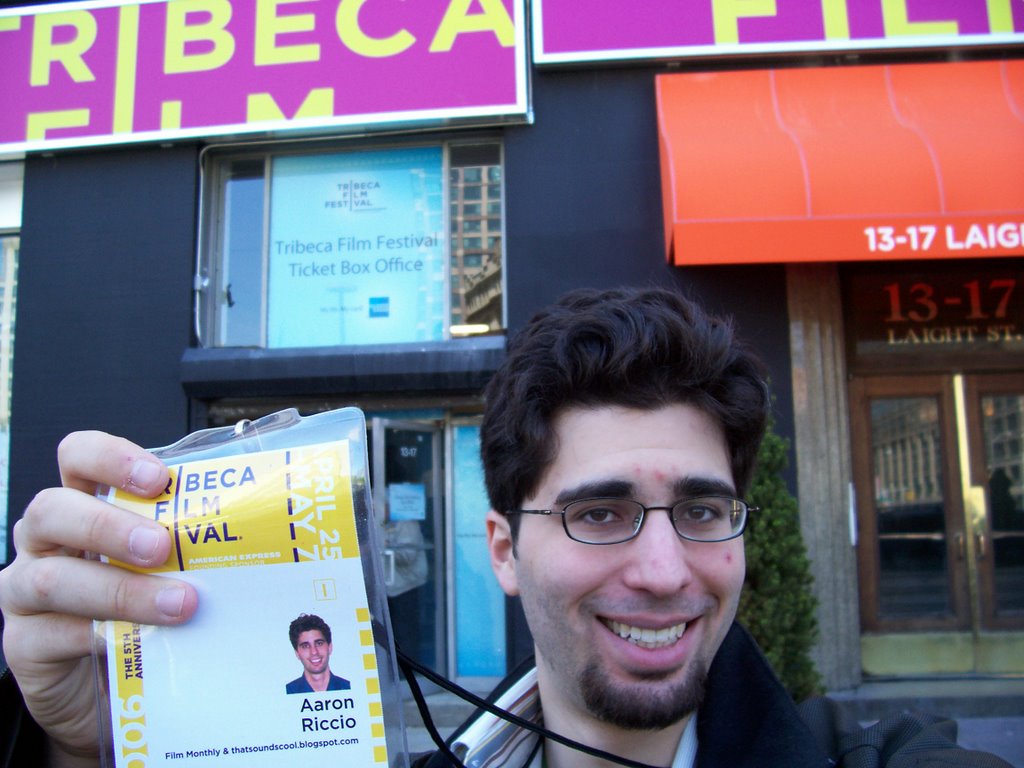
This photo doesn't show it, but at this point
I'm really, really sick. As if that's going to stop me.
I'm really, really sick. As if that's going to stop me.
--- Pittsburgh
Thank god for Jeff Goldblum. Not that he's an amazingly deep actor, or an incredibly varied performer, or anything Oscar-worthly like that. But he is sincerely insincere, and for that, we love him. His new film, Pittsburgh, is a narrative documentary that looks at Jeff Goldblum's turn as Henry Hill in a regional production of The Music Man. Goldblum quickly gets himself in too deep, drawing scorn from his agent, the love of his girlfriend, and the skepticism of his best friend (Ed Begely, Jr.). The difference between Pittsburgh and the fourth season of Curb Your Enthusiasm (where Larry David joins the cast of The Producers), is that Goldblum really did perform in the two-week production, which makes the line between reality and improvisation a lot harder to see. And that's all the merrier for the audience, since it makes the self-deprecation and parody more potent.
A couple of things don't work, such as a side-plot about Ed Begely, Jr.'s "Solarman 2000" (a portable solar device), and most of the training footage is spliced into an unsatisfying montage format. One also wonders exactly why Moby is in this film (amusing as it is to picture him as a sleazy rock star who gets off on pictures that his female fans send him of themselves masturbating). There are a lot of disconnects like this (which is bound to happen when you try to cobble together 400 hours of footage into a narrative), but when the movie sticks on point (and it usually does), it is hysterical. As the days grow longer and the performance approaches, the commentary on movie stars tackling real theater becomes more exciting, and the barbs (mostly at Goldblum's expense, e.g., the director's unkind words to him) grow ever more amusing.
There's a lot to like about Pittsburgh (the movie, at least), and it's a feel good comedy. And nobody (not even Goldblum) was hurt in the making of this film.
--- Lonely Hearts
For all the beautiful camera work and lush 1949 stylings, there's something very . . . well, lonely about Lonely Hearts. Todd Robinson does fine as a director, and he handles his actors well, but there's something oddly disconcerting about the script's dramatic structure. The violence is stark enough, but just as the troubled cop (John Travolta) is left feeling troubled at the film's end, so is the audience. It's not that justice hasn't been served, and it's not that Jared Leto and Salma Hayek don't channel pure evil as the Lonely Hearts Killers (Hayek especially) -- it is perhaps the lack of any real sideplot or anything beyond just the chase itself, and its Hollywood ending. The drama seems to have been sucked dry: we may study these characters, tortured individuals all, but we can't hope to understand them, nor are we really drawn into the struggle. There's just not enough for us to get attached to.
This is a good vehicle for all the actors attached (with the exception of James Gandolfini, who is, and will always be, a trademark character), and the vehicle itself looks slick. But by spoiling the end of the film at the beginning, and by a lot of other narrow-minded choices, Robinson doesn't actually take us anywhere, except around in a big, pointless circle.
Subscribe to:
Posts (Atom)

